|
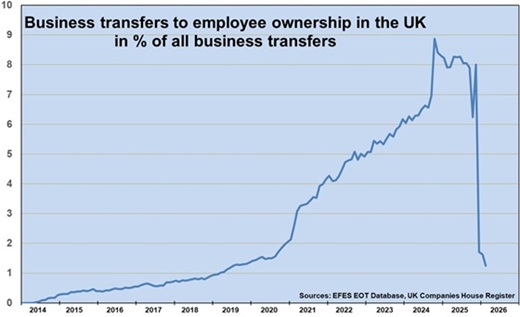
Over
the past ten years, employee ownership in SMEs has seen
extraordinary growth in Great Britain. We were rapidly
moving towards a situation where one in ten SMEs would
be employee-owned. In most cases, employees become 100%
owners of their company. Without having to spend a single
penny of their own money. This success was due to the
introduction of the Employee Ownership Trust
mechanism in 2014.
And
then... Rachel Reeves, the new Chancellor of the Exchequer
in the UK government decided to retax business transfers
to employees. Instead of a 100% tax exemption on capital
gains when transferring a company to employees, this
exemption has now been cut to 50%. The effect is dramatic.
Overnight, business transfers to employees in
Great Britain have been abruptly stopped.
Commenting
on her decision, Ms. Reeves concluded that a 50% incentive
rate was still a lot; this would enable the successful
transfer of businesses to employees to continue.
Ms. Reeves lied. She knew the effect would be disastrous.
She had been warned by a report she had received. That
report contained details of the two main tax incentives
offered under the EOT (Employee Ownership Trust) legislation.
The first incentive is for the party selling the company.
That party is exempt from tax (Capital Gains Tax relief)
on the sale of the company to an EOT. This is the incentive
that Ms. Reeves has chosen to reduce to 50% instead
of 100%. The report to Ms. Reeves stated that this incentive
is “a strong selling-point of the EOT model” “that made
it more financially desirable than other forms of business
disposal”. So “changes to CGT relief would have made
the prospect of transitioning to an EOT model less appealing”.
The second incentive concerns the profits distributed
by the EOT to employee owners after the company has
been sold. Up to £3,600 a year, this distribution can
take the form of a tax-free bonus. According to the
report, this incentive is not decisive for the success
of the EOT model, rather it is “seen as an additional
"nice to have" rather than a key driving factor
in the decision to use an EOT model.”
To complete the picture, the following needs to be known:
the first incentive is a “one shot”. Not only is it
highly effective, it is also inexpensive for His Majesty's
Treasury. The second incentive, on the other hand, is
not indispensable, but is repeated year after year,
which ends up being very costly for the Treasury.
And here is the biggest falsehood of all. Ms. Reeves
said she was concerned about reducing the cost of the
EOT model to His Majesty's Treasury. However, instead
of reducing the second incentive, which is very costly
and ineffective, Ms. Reeves chose instead to reduce
the first incentive, which is inexpensive and highly
effective. A strange calculation for His Majesty's finances!
What is the conundrum here? Please be patient, the explanation
will come in a future edition of this chronicle. Some
readers in the UK may already be familiar with it. Do
not hesitate to send us your information and stories,
which will certainly be of help to us in the future.
There
is only one way to avert disaster. It is essential
to reinstate the 100% exemption on capital gains relating
to the sale of a company to employees.
More
info
|