Here is www.efesonline.org Last update: 15.10.2026
EFES NEWSLETTER SPONSORS
Welcome, this is the EUROPEAN FEDERATION OF EMPLOYEE SHARE OWNERSHIP (EFES). The EFES acts as the umbrella organization of employee owners, companies and all persons, trade unions, experts, researchers, institutions looking to promote employee share ownership and participation in Europe. The EFES was recognized by the European Commission (DG Enterprise and Industry) as the European Business Representative Organization in the field. This site is basically written in English but for detailed info is multilingual:
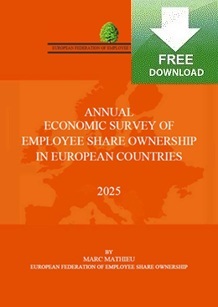
EUROPEAN SURVEY 2025
197 pages evolution 2006-2025 main findings of census 2025 more than 100 tables and graphs democratization rate in various countries list of all most remarkable companies ordinary employees and top executives employee representation on boards discrimination in voting rights listed companies employee-owned non-listed companies ownership and more More info
EMPLOYEE OWNERSHIP IN EUROPEAN SMEs Collective employee ownership allows employees to become 100% owners of their company without paying a cent out of pocket. Since 1974 in the USA and since 2014 in the UK, this already applies to thousands of companies and million people. More info
MEMBERSHIP
The EFES is a partner member of the European Federation of Investors and Financial Services Users
REPORT FOR THE EUROPEAN COMMISSION
"Employee share ownership for all" - this is the goal of the European Policy for 30 years.
Today we have 10 million employee shareholders in Europe. However we would need to multiply that number six-fold to be comparable with the USA. Despite significant progress in Europe, the goal is still far from being achieved, especially in SMEs.
The "missing link" is a European Action Plan. It was requested by the European Council in 2000, announced by the Commission in 2002, prepared by a Pilot Project in 2014, the need was reaffirmed through the European Parliament's Resolution of 23 October 2018. It has now to be put in place.
Download
Testimonies
"Thank you so much. Just what I was looking for. For the moment I try to help one of our larger financial institutions (a bank) with their EO programme. To give them an idea about EO amongst other similar companies, I am looking for some statistics or other information about EO in European financial institutions like banks, insurance companies and others. I'll look into more details in your database."
"Merci à vous pour toutes les données fournies et pour toutes les réponses toujours rapides et concrètes à mes demandes."
"Thank you for continuing to send me this resourceful and excellent newsletter."
"It worked! Great! Fantastic data base! Thanks"
"Merci mille fois de cette disponibilité pour nos travaux. Je fais travailler l'équipe sur le rôle des salariés dans la gouvernance. Y inclus évidemment l'actionnariat salarié et là avec un angle de tir spécifique: une comparaison de ce que prévoit la loi Florange par rapport à l'existant en France et surtout dans les autres pays de l'Union européenne. Evidemment vous êtes THE REFERENCE !"
"Un ulteriore ringraziamento va infine al Dott. Guido Antolini, Presidente della EFES, per avermi illustrato il lavoro di quest'associazione e fornito consigli in merito all'oggetto del mio elaborato."
"Je recherche des données macroéconomiques récentes sur l'actionnariat salariés en Europe plus précisément sur la branche ETI/Grands Entreprises, entreprises cotées et non cotées?"
"Could you please add me to your mailing list? I am a correspondent for a UK magazine on employee benefits, so any UK news would be of particular interest."
"Nos plus vifs remerciements pour votre intervention au Salon Actionaria. Les retours sur cette table ronde sont dithyrambiques…"
"Thanks again for your reactivity about these very useful elements."
"Travail remarquable ! Merci et félicitations".
"I would be very eager to update my analysis based on new data."
"Merci de votre lettre d'information que je lis toujours avec intérêt : la progression de l'actionnariat salarié a été remarquable ces dernières années et votre action a participé à la convergence des législations nationales et à la prise de conscience par les entreprises européennes du formidable potentiel que représente cette forme d'actionnariat. La conclusion, vous l'écrivez dans l'éditorial : les prix des actions augmentent d'autant plus que la part d'actionnariat salarié est importante. A action remarquable, résultat remarquable : toutes mes félicitations et que cette année 2014 s'inscrive dans cette "success story" que vous contribuez à réaliser !"
"Can you provide data on individual companies, e.g. in an excel spread sheet, so we can see which companies have stock options? This would be very useful for our statistical analysis."
"Sans votre soutien précieux, en m'aidant à constituer la base de données statistiques ayant permis la réalisation des deux études quantitatives longitudinales de l'impact de l'actionnariat salarié sur la performance des grandes entreprises françaises cotées, ma thèse n'aurait pas pu voir le jour."
"The EFES has done a great job on developing their database on employee share ownership, which now can help on doing more accurate and reliable study on this topic."
"I have been working on a research paper for which we use the EFES dataset and we have now received positive feedback from the reviewers of the British Journal of Industrial Relations."
"I used your database which was very useful to me… Im preparing a master thesis about employee ownership in Switzerland."
"Thank you very much for your extreme reactivity. That seems to be a first measurement tool of very high quality."
"Nous sommes en phase de finalisation du texte concernant une saisine au CESE en France. Votre publication pourrait nous être fort utile."
"Muchas gracias por la información y felicitaciones..."
"Kunt u me laten weten waar ik beknopte informatie zou kunnen vinden over de verschillende systemen inzake werknemers-participaties in bedrijven ?"
"I have to thank you once more for your answers which I included in my article."
"Je suis journaliste marocain, au journal "le Matin", du groupe Maroc Soir, le plus grand groupe de presse au Maroc. Nous préparons un dossier sur l'actionnariat salarié ou salarial. Dans ce cadre nous souhaitons partager avec nos lecteurs votre expérience sur le sujet"
"I'm trying to answer why the Netherlands is falling behind other european countries with ESOPs."
"Corey Rosen of the National Center for Employee Ownership suggested I get in touch with you. We are an equity risk management firm based in California"
"With the government in the UK considering and currently consulting on proposed income tax and NICs exemptions for employees of companies in the indirect employee ownership sector i.e. those where the shares are held by an employee trust or similar I would be interested to learn whether other countries have or are considering such exemptions."
"Thank you Marc, very interesting indeed and useful for the Centre in persuading the UK government that it is too focused on the 'employee-owned' sector instead of employee share schemes in larger quoted companies."
"I prepare a few articles about employee ownership praxis in Slovenia and also what is new in Europe"
"We are working on a paper that we aim to publish in the British Journal of Industrial Relations, and I attach the current version for your reference. As you will see, we are using information from the EFES database for our analysis. The BJIR is a highly respected journal in its field"
"Let's all congratulate Philippe Lepinay, Chairman of the French Federation of Employee Shareholders' Associations for his fresh nomination as "Chevalier de la Légion d'Honneur", recognizing his work together with all French colleagues for the promotion of employee share ownership."
"Could you please supply me with more detailed information on both the Parliament Budget heading as well as on your Project in order to present the idea formally to the head of the Inter-University Centre, Professor Roggemann, and the faculty board."
"EFRAG (European Financial Reporting Advisory Group)'s aim is to provide input into the development of IFRS issued by the IASB and to provide the European Commission with technical expertise and advice. EFRAG wants to enhance our involvement with the investor and user community with as aim to increase the influence of users on EFRAG's positions and in international accounting standard setting process. In this respect we would appreciate to have a conversation with EFES..."
"J'ai été très intéressé par la dernière newsletter de votre association et notamment par le volet consacré à la présence des salariés dans le conseil des entreprises ce qui semble une chose inexistante en Belgique. Pourrait-on en parler ? Si vous en aviez la possibilité, je pourrais vous recevoir à La Libre Belgique."
Employee share ownership is not a cuckoo A dangerous and irritating situation occurred about employee share ownership within the OECD in 2015. It was suggested that ESOPs and employee share ownership should be discouraged because putting all employees' eggs in the same basket, especially considering pension savings. Fortunately, the OECD heard our claims. We were informally informed that the new "Core Principles of Private Pension Regulation" will be adapted in accordance with our views. The principle of diversification applies to employee share
ownership as to any other financial investment. It is illustrated by the aphorism "do not put all eggs in one basket." However, employee share ownership is not just a financial investment. It also has the character of an industrial investment. This character is most evident when the employees' stake reaches 100% of the company's capital, which is the typical case of employee share ownership in SMEs. However, it is also present, although more incidentally, to the minority employee share ownership in large companies. If the aphorism of eggs and basket frequently applies to the diversification of financial investments, another aphorism applies better to industrial investment: "The bird lays all eggs in the same nest". Among the few exceptions, the example of the cuckoo is well known. It must be said: Employee share ownership is not a cuckoo. More information
Worldwide practical evidence and a wide range of academic research support the view that a proper legal environment and the provision of suitable fiscal incentives are indispensable prerequisites for any policy truly aiming the development of employee share ownership. Moreover, such evidence and research also show that fiscal incentives always pay off medium/long term and in many ways. Organizations promoting employee owner-ship around the world have demanded persistently and consistently supportive legislations including fiscal incentives for the common good (evidenced in additional growth and profitability, the spread of wealth, contribution to economic and social stability). New fiscal incentives pave the way to new encouraging development, while political decisions reducing or cutting such incentives always lead to regression.
The political roadmap for employee share ownership in Europe The political roadmap for Europe was first proposed in the framework of the French Presidency of the European Union in 2008. Detailed information
For information and contact EFES - EUROPEAN FEDERATION OF EMPLOYEE SHARE OWNERSHIP FEAS - FEDERATION EUROPEENNE DE L'ACTIONNARIAT SALARIE Avenue Voltaire 135, B-1030 Brussels Tel: +32 (0)2 242 64 30 - Fax: +32 (0)2 791 96 00 E-mail: efes@efesonline.org Web site: www.efesonline.org EFES' objective is to act as the umbrella organization of employee owners, companies and all persons, trade unions, experts, researchers, institutions looking to promote employee share ownership and participation in Europe.







 The political roadmap for employee share ownership
in Europe
The political roadmap for employee share ownership
in Europe