|
EFES NEWSLETTER - APRIL 2026
|
|
JUST
RELEASED
The
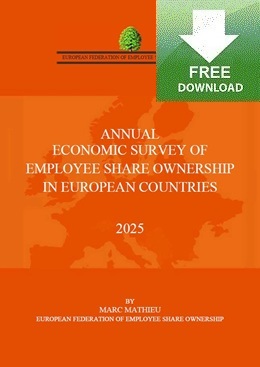
new "Annual Economic Survey of Employee Share Ownership
in European Countries" is just released
More information
in
partnership with


|
|
 Employee
share ownership in Europe in 2025
Employee
share ownership in Europe in 2025
1.
The paradigm shift in European employee share ownership
gained further traction in 2025. As far as employee
share ownership is concerned, the dynamic is shifting
from large companies to SMEs. The context and objective
are not so much to share profits as to meet the need
for business succession. Great Britain is becoming Europe's
number one, while the continent and France in particular,
are fading into the background.
2. When it comes to employee share ownership in large
European companies, the paradox is increasingly glaring.
Everything indicates that companies want it. Everything
indicates that employees want it too. Companies are
increasing the number of employee share plans. In terms
of value, records continue to be broken. 497 billion
Euro held in 2025, or 45,000 Euro for the average employee
shareholder.
Yet overall, the number of employee shareholders is
falling, employee ownership stake is stagnating, and
the democratisation of employee share ownership is crumbling.
As a result, the plans are becoming less and less effective.
The plans and policies behind them are becoming increasingly
undemocratic.
On the positive side, an increasing number of large
European companies are introducing employee share ownership
plans and seeing a greater uptake in employee share
ownership. In
2025, 95% of large companies had some form of employee
share ownership and 59% had democratic plans for all
their employees.
However, the number of employee shareholders
has dropped to 6.5 million, still below the level of
6.9 million reached in 2011. The rate of democratisation
of employee share ownership continues to fall. Today,
only one employee in five is a shareholder in their
company, compared with one in four previously. Finally,
employee shareholding in large European companies has
stopped growing. It represents 3.07% in 2025 versus
3.04% in 2013.
3. A strong employee ownership movement is now taking
hold in European SMEs, starting in Great Britain. In
2025, the UK was rapidly moving towards a situation
where one in ten SMEs would be 100% employee-owned.
For employee share ownership worldwide, this marks a
true revolution. In fact, for almost two hundred years,
numerous frameworks and models have been tried and tested
to develop employee ownership in SMEs. Today, for the
first time in the world, we have succeeded in setting
up a model that outperforms all others. Since 1974,
the world's best-known model had been the ESOP plan
in the United States. The Employee Ownership Trust
formula introduced in the UK in 2014 now appears to
be by far the most effective.
|
|
Great
Britain – It's
already been 4 months
|
|
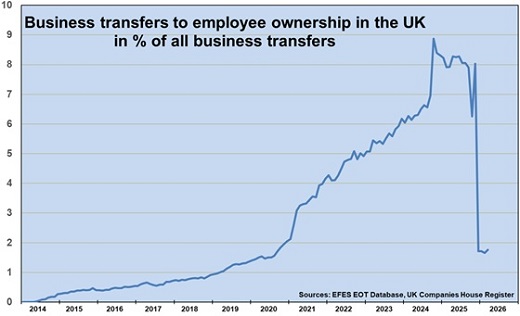
Over
the past ten years, employee ownership in SMEs has seen
extraordinary growth in Great Britain. We were rapidly
moving towards a situation where one in ten SMEs would
be employee-owned. In most cases, employees become 100%
owners of their company. Without having to spend a single
penny of their own money. This success was due to the
introduction of the Employee Ownership Trust
mechanism in 2014.
And
then... Rachel Reeves, the new Chancellor of the Exchequer
in the UK government decided to retax business transfers
to employees. Instead of a 100% tax exemption on capital
gains when transferring a company to employees, this
exemption has now been cut to 50%. The effect is dramatic.
Overnight, business transfers to employees in
Great Britain have been abruptly stopped.
There
is only one way to avert disaster. It is essential
to reinstate the 100% exemption on capital gains relating
to the sale of a company to employees.
More
info
|
|
|
Press
review
A
selection of 24 remarkable articles in 5 countries in March
2026: Canada, France, Sweden, UK, USA.
Canada:
Jon Shell summarizes the credo of business succession to employee
ownership.
France: The cooperative model as a guarantee of French
sovereignty. Business transmission to employee ownership is
the solution France is ignoring. The proportion of employee
shareholders is at its lowest in Europe.
Sweden: Employee share ownership trust for Fabege.
UK: Startups – the ghost of the 28th regime returns
to haunt Europe. Where will it be established, and who will
finance it? California and Texas are at the forefront. Still
a few isolated cases of business transfers to Employee Ownership
Trusts.
USA: The Trump Administration at the initiative, -
the Department of Labor rewrites the history of employee ownership.
Business transmissions through various trust models. First
Employee Ownership Trust for Ohio.
The full press review is available
on:
https://www.efesonline.org/PRESS
REVIEW/2026/March.htm
|
A
political roadmap for employee ownership in Europe
The
EFES needs more members. Download the EFES membership form
What's
new on the EFES website?
EFES NEWS
distribution: 200.000
|