| |
NOTICIAS
 Dia tras dia, todas las
noticias sobre el accionariado asalariado en el
net
Dia tras dia, todas las
noticias sobre el accionariado asalariado en el
net
|
 Febrero
2022
- Desastre
en Noruega
Febrero
2022
- Desastre
en Noruega
|
|

Se
acabó. El nuevo gobierno noruego suprimió
a partir del 1 de enero todos los incentivos
para la participación accionarial de los empleados.
Por lo tanto, es el momento de abrir un debate
político. ¿Qué podemos hacer? ¿Cuál es la
alternativa? Tal como decía un primer ministro
socialista que tuvo su momento de gloria en
Bélgica: "Primero actúo y después pienso".
Para el Partido Socialdemócrata noruego, la
participación accionarial de los empleados
era un factor de desigualdades. Lo sustituirá
por beneficios fiscales para las opciones
sobre acciones en las empresas emergentes,
lo que seguramente será mucho más igualitario.
En estos momentos, en Europa existe una obsesión
política por las start-up.
En la Comisión Europea, el Comisario Thierry
Breton pronunció un discurso parecido hace
algún tiempo. Destacamos el retraso que existe
en Europa para la participación accionarial
de los empleados en las PYMES, así como la
necesidad de introducir en Europa herramientas
financieras adecuadas para la transmisión
de la empresa a los empleados. "The job
is done", o el trabajo ya está hecho,
cabría decir: en pocos meses hemos puesto
en marcha una estrategia europea para promover
el uso de las opciones sobre acciones en las
empresas emergentes.
Esta estrategia europea (la Startup Nation
Standard de la UE) consiste básicamente en
pedir a los Estados europeos que actúen, que
es lo que aparentemente está ocurriendo también
en Noruega.
Nuestra respuesta fue que una estrategia dirigida
a las 20.000-30.000 empresas emergentes europeas
existentes no puede responder a las necesidades
de las PYME europeas. De hecho, la Unión Europea
cuenta hoy con dos millones de PYMES que emplean
a 50 millones de personas (sin contar los
23 millones de microempresas que también emplean
a casi 50 millones de personas).
Con un razonamiento así, Europa podrá llegar
a Marte sin cohetes, ya que hoy disponemos
de unas excelentes bicicletas eléctricas.
Tal como se puede ver en nuestra revista de
prensa, al menos en Noruega el debate promete
ser acalorado.
|
|
Enero
2022
- Planes
modelo
|
|
¿Qué es el accionariado asalariado? El accionariado
asalariado es cuando empleados tienen una
participación en el capital de la empresa
en la que trabajan. Comienza con un empleado
en posesión de una acción y puede extenderse
hasta el 100% de las acciones poseídas por
todos los empleados.
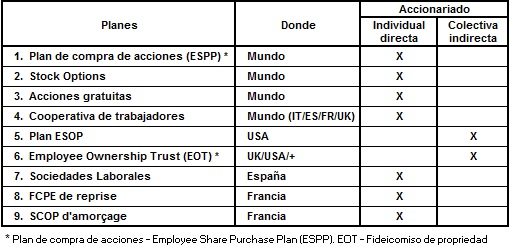
Existe
un pequeño número de modelos de planes de
participación accionarial de los empleados
en todo el mundo (pero con muchas variaciones
en función de la legislación específica de
cada país). Estos planes están más o menos
adaptados a las empresas emergentes o startups
(o microempresas) o a las PYME o grandes empresas.
Al
igual que la propiedad corporativa en general,
los planes de participación accionarial de
los empleados pueden dividirse en dos categorías
principales: propiedad individual directa
de acciones y propiedad colectiva indirecta
de acciones:
La participación accionarial individual directa
de los empleados es la forma más tradicional
y conocida. Para ello, el trabajador utiliza
parte de sus ahorros o recursos financieros
para comprar acciones de la empresa, asumiendo
así un riesgo personal. Esto es posible en
varios tipos de planes. Esta categoría de
planes de participación accionarial de los
empleados es prácticamente la única de este
tipo en Europa continental.
La propiedad colectiva indirecta de los empleados
se practica muy poco en Europa (excepto en
el Reino Unido). De ahí que la participación
accionarial de los empleados en Europa sea
casi inexistente en las PYME, y prácticamente
desconocida fuera de las grandes empresas.
De hecho, las PYME suelen evitar aumentar
su número de accionistas, sean o no empleados.
Sólo se ven obligadas a hacerlo cuando se
hacen más grandes.
Por otro lado, una fase concreta puede desencadenar
el deseo de nuevos accionistas: Transmisión
de empresas. Es el mejor momento para introducir
la participación accionarial de los empleados
en las PYME. La propiedad colectiva indirecta
es la forma más adecuada para transferir una
empresa a los trabajadores. Los planes pertenecientes
a esta categoría (ESOP, EOT) han sido diseñados
con este fin. Permiten a los empleados adquirir
la propiedad de su empresa, a menudo el 100%,
sin tener que utilizar sus ahorros o sus finanzas
personales y, por tanto, sin riesgo personal.
Los planes de participación accionarial colectiva
indirecta de los empleados (ESOPs, EOTs) facilitan
la transferencia de empresas a los empleados,
algo que los planes de participación accionarial
individual directa sólo pueden lograr con
gran dificultad y gastos, ya que los ahorros
de los empleados no suelen estar a la altura.
Leer Más
|
|
Diciembre
2021
- Amenaza en Noruega
|
|

Que empieza en Dinamarca.
Una de las primeras acciones del nuevo gobierno
danés en 2011 (Helle Thorning-Schmidt, socialdemócrata),
reflejó la obsesión por la crisis financiera
y decidió poner fin a todos los incentivos
para la participación de los empleados. Cinco
años después, en 2016, una de las primeras
acciones del nuevo gobierno danés (Lars Rasmussen,
conservador-liberal) fue restituirlos.
Pero
no funcionó. Inexorable inestabilidad política.
La reinversión en nuevos planes de participación
de los empleados no se produce, las empresas
no los restablecen.
Hoy, Dinamarca es nuevamente dirigida por
un gobierno socialdemócrata. Este último sueña
con promover empresas "democráticas".
Y ahora le toca a Noruega.
No es el país mejor situado de Europa para
el desarrollo de la participación de los empleados
ya que solo cuenta con 40.000 accionistas
asalariados, lo que representa cerca del 10
% de los empleados de las grandes empresas.
Para ponerse al corriente, el gobierno noruego
decidió aumentar los incentivos para la participación
de los empleados en 2021.
Pero entre tanto, las elecciones. Nuevo gobierno
socialdemócrata. Sorpresa, el proyecto cambia.
El objetivo ahora es suprimir todos los incentivos
fiscales para la participación de los empleados
por considerarlos una fuente de desigualdades.
Sin embargo, hace tiempo que se sabe que la
participación de los empleados no sólo beneficia
a los beneficiarios directos y a las empresas,
sino también a la calidad de vida y a la población
en general.
En la prensa noruega, los argumentos a favor
y en contra se enfrentan, las organizaciones
y los sindicatos están divididos...
Ver
el revista de prensa
|
|
Noviembre
2021
Go
Ape Adventure Forest - Nueva
sociedad laboral en el Reino Unido
|
|
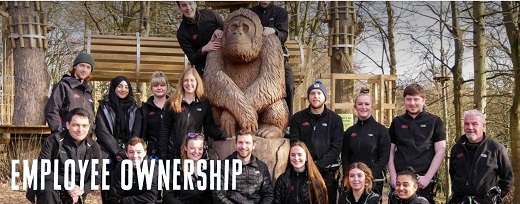
Los
fundadores Rebecca y Tristram Mayhew anunciaron
el 23 de octubre de 2021 que el 90 % de las
acciones de Go Ape se transferirán a un fideicomiso
de propiedad de los empleados, en beneficio
de todos los empleados actuales y futuros.
El 10 % restante del negocio lo conservarán
Rebecca y Tristram.
Desde la constitución de Go Ape en 2002, la
empresa, que se enorgullece de ser independiente,
ha experimentado un crecimiento "verdi-ginoso".
Casi 20 años después, han creado una empresa
de aventuras en el bosque galardonada con
múltiples premios y que cuenta con 35 centros
en toda Gran Bretaña. Recibe más de un millón
de visitantes al año y cuenta con un equipo
de mil personas en el Reino Unido. Go Ape
también se ha expandido al otro lado del charco
y está presente en 16 estados de Estados Unidos.
¿Cuál es la nueva estructura de gobierno de
Go Ape?
Antes de transferir la gran mayoría de sus
acciones a un fideicomiso de propiedad de
los empleados en beneficio de todos los empleados,
los fundadores de Go Ape elaboraron una declaración
de pretensiones para la empresa en el futuro.
Esta declaración recoge los deseos de los
fundadores –"The Founders’ Wishes"–
y se basa en los valores fundamentales que
dieron forma a la dirección y la toma de decisiones
de los primeros 20 años de Go Ape.
Más información en
The Founders'
Wishes
|
|
Octubre
2021 - La
Coalición 1BY30
|
|
La
coalición 1BY30 nació en el Reino Unido y
reúne a las principales organizaciones del
movimiento cooperativo y que promueven la
participación de los trabajadores en el accionariado:
Co-operatives UK y Employee Ownership
Association.
Hacen campaña por lograr 1 millón de propietarios
para el 30, es decir, un millón de trabajadores
que participen en el accionariado de las PYMES
británicas para 2030. Más
que en toda la Unión Europea en la actualidad.
En los últimos años, en el Reino Unido ha
aumentado la demanda de asesoramiento y apoyo
profesional en relación con la participación
de los trabajadores en el accionariado de
las empresas. Por ese motivo, la coalición
decidió crear The Ownership Hub.
|

|
|
The
Ownership Hub trata de un ente destinado
a elaborar recursos y programas de formación
para que los asesores profesionales puedan
apoyar a los empresarios y a las empresas
a adoptar el régimen de participación de los
trabajadores en el accionariado y de cooperativas
de trabajadores en diferentes etapas del ciclo
de vida de las empresas.
Las cooperativas de trabajadores constituyen
el modelo establecido para crear empresas
que sean propiedad de los trabajadores desde
el inicio. Asimismo, es habitual que las empresas
jóvenes apuesten por un modelo cooperativo
para realizar la transición a la participación
de los trabajadores en el accionariado en
una fase temprana.
También las empresas de nueva creación utilizan
con frecuencia sistemas de participación de
los empleados, en particular opciones sobre
acciones.
En cambio, el panorama es muy diferente con
respecto a la sucesión patrimonial. Con vistas
a transmitir una empresa a sus empleados,
los medios más eficaces, en muchas ocasiones,
son los programas de propiedad de acciones
para empleados (ESOP) y los trusts para poner
en marcha planes de participación en el capital
para empleados (EOT).
Más información en
The
Ownership Hub
|
|
Septiembre
2021 - El
accionariado asalariado impulsa la recuperación
económica de Escocia
|
|
Para
2030 el Gobierno escocés espera que el país
cuente con 500 sociedades laborales, frente
a las poco más de 100 que en la actualidad
han optado por crear trusts a fin de poner
en marcha un plan de participación en el capital
para sus empleados. Decenas de miles de nuevos
empleados con participación en el accionariado
de sus empresas.
El
gobierno está siendo testigo de un verdadero
despertar en cuanto a los beneficios que aportan
las empresas que pasan a ser propiedad de
su personal, no sólo a nivel personal, sino
por el hecho de que aseguran puestos de trabajo,
riqueza y talento para Escocia. No puede ignorarse
la función que desempeña la participación
de los trabajadores en el accionariado de
las empresas en la recuperación a largo plazo
tras la pandemia de coronavirus.
La
transición a la propiedad de los empleados
suele ser impulsada por empresarios o empresas
familiares como parte de sus planes de sucesión.
¿Cuáles
son las ventajas para los vendedores? ¿Qué
ventajas supone para los empleados? Veamos
los hechos: Consulte en nuestro resumen de
prensa una docena de casos reales y testimonios
extraídos la prensa británica este verano.
Ver
más
|

|
|
Julio
2021 - Meld
Studios
La primera empresa australiana que se
convierte en un fideicomiso de accionariado
asalariado
|
|

¡Tenemos
una nueva estructura de propiedad!
Después
de un año de influir en la legislación australiana,
nos complace anunciar oficialmente nuestro
paso a un fideicomiso de accionariado asalariado.
Este es un gran hito en la historia de Meld,
y en la historia de la propiedad de las empresas
en Australia.
¿Qué
significa ”fideicomiso de accionariado asalariado”?
Técnicamente,
un fideicomiso de accionariado asalariado
(Employee Owned Trust o EOT) es:
Un
fideicomiso creado por una empresa para mantener
el capital en nombre de sus empleados, y en
el que, por lo general, todas -o al menos
la mayoría- de las acciones están en manos
del fideicomiso.
En
la práctica, un EOT significa que:
·
Las acciones de nuestros tres fundadores
(propietarios) se transfieren gradualmente
al EOT de Meld
·
Todos los empleados permanentes son
beneficiarios de este fideicomiso
·
Como beneficiario, cada empleado es
propietario indirecto de Meld
·
Cada empleado de Meld tiene dos roles:
empleado y propietario de la empresa
·
Cada empleado de Meld tiene voz y voto
en la dirección de la empresa a través de
las estructuras administrativas
·
Todos los empleados de Meld participan
por igual en los resultados del esfuerzo colectivo.
Toda
la historia
|
|
Junio
2021 - El
accionariado asalariado y la economía post-Covid
|
|
El
Reino Unido busca rediseñar los planes de
accionariado asalariado para la década de
2020.
Acaba
de publicarse un informe con recomendaciones
para ampliar el uso de los planes de accionariado
asalariado mientras el Reino Unido se centra
en la recuperación económica después de Covid:
"A
Stake in Success - Employee Share Ownership
and the post-Covid economy".
Esto
se lo debemos a la Social Market Foundation
y a Proshare, la voz del sector de los planes
de accionariado asalariado en el Reino Unido.
Aporta
algunas recomendaciones importantes, entre
ellas:
•
Hay que ampliar la participación en
los planes de accionariado asalariado, y una
parte clave de esto podría ser el rediseño
de los planes con ventajas fiscales para ampliar
su atractivo para los trabajadores con ingresos
más bajos. "Hay que modificar las normas
del plan de incentivos de acciones (Share
Incentive Plan) para permitir un acceso
preferente a las acciones gratuitas a los
trabajadores con ingresos más bajos."
•
"Introducir un nuevo modelo de
propiedad para que el accionariado asalariado
sea una parte clave de la planificación de
la sucesión empresarial. El modelo ESOP de
Estados Unidos debería introducirse en el
Reino Unido, y los trusts de accionariado
asalariado (Employee Ownership Trusts
o EOTs) deberían tener la opción de convertirse
en planes ESOP, donde las acciones se asignan
a los empleados individuales en lugar de mantenerse
en un fondo colectivo. La adopción de planes
EOT y ESOP como parte de la planificación
de la sucesión empresarial podría ayudar a
ampliar la propiedad de los empleados con
el tiempo."
•
"El gobierno debe apoyar el accionariado
asalariado, convirtiéndolo en una parte clave
de la agenda económica y de la narrativa post-Covid.
Debería ser un componente clave no sólo para
una "recuperación justa", sino también
para abordar el viejo problema de la economía
británica de la falta de productividad."
|
|
|
Mayo
2021 - Una
campaña de desinformación en Francia
|
|
En
los últimos meses se ha producido una oleada
de traspasos de empresas a empleados en todo
el mundo. Es un desarrollo a raíz de la pandemia.
Tras la crisis, muchos propietarios de PYMES
tienen una visión diferente de la vida y quieren
transferir sus empresas.
En estos momentos, en el Reino Unido se transfiere
cada día una PYME a sus empleados, una media
de 85 personas. ¡Una PYME cada día!
Los empleados se convierten en accionistas
mayoritarios de la empresa, normalmente incluso
al 100%, como ocurre en las SCOP, las cooperativas
de empleados en Francia.
Esto ocurre gracias al plan de accionariado
asalariado ESOP y a su variante británica,
el EOT(Employee Ownership Trust).
No se trata de planes de compra de acciones
como los conocemos en París en las grandes
empresas. Los empleados no tienen que invertir
sus ahorros. Además, sus ahorros no serían
suficientes para comprar su empresa. En el
modelo ESOP, los empleados no asumen el riesgo
financiero.
En varios países, el movimiento cooperativo
es una de las puntas de lanza de los planes
de accionariado asalariado ESOP en las PYME.
Lo mismo ocurre con el movimiento sindical.
Este es el caso en Gales con el Wales Co-operative
Centre (Centro Cooperativo de Gales) o
en Escocia con la agencia Co-operative
Development Scotland (Desarrollo Cooperativo
de Escocia).
En cambio, Francia ofrece un panorama sorprendente
en este momento. De hecho, es gracias a una
campaña de desinformación organizada por la
prensa y los grupos de presión políticos,
que el modelo ESOP fue acogido en Francia.
Esta campaña está dirigida por la FAS, organización
que agrupa a una docena de asociaciones activas
de accionistas asalariados en grandes grupos
empresariales en París. Más
información
|

Supermenteur
|
|
Mayo
2021 - Nueva
legislación en Alemania
|
|
La
nueva legislación sobre el accionariado asalariado
fue aprobada por el Bundestag el 22 de abril.
Es un gran paso adelante. Los incentivos fiscales
se multiplican por cuatro, es decir, 1.440
€ al año y por persona. Cabe esperar que muchas
más empresas recurran al accionariado asalariado,
tanto las grandes como las PYME y las nuevas
empresas. Las decisiones políticas en Alemania
se han acelerado repentinamente. Sin embargo,
aún estamos lejos de las exigencias de la
práctica y las normas internacionales (véase
nuestra revista de prensa). Más
información
|
|
Marzo
2021 - Un
éxito francés
|
|
Desde
principios de año, el número de Trust de Accionariado
Asalariado (Employee Ownership Trusts)
en el Reino Unido ha crecido a un ritmo cada
vez mayor.
A este ritmo, el número de empresas que se
transfieren a los empleados se duplicará este
año, hasta alcanzar entre 6 y 700. En pocos
años, desde que se implementó la fórmula en
abril de 2014, ha sido un gran éxito.
En
comparación, Francia introdujo un sistema
“FCPE de adquisición” en 2006.
También en Francia la cifra aumenta considerablemente.
De hecho, entre 2006 y 2020 sólo se han producido
dos casos de traspaso de empresas a "FCPEs
de adquisicion", pero esta cifra podría
aumentar a tres en 2021, es decir, un 50%
más. Esto situaría a Francia no muy lejos
del +100% previsto en el Reino Unido y, en
cualquier caso, muy por encima de todos los
demás países europeos.
|
|
|
El
FCPE de adquisición se diseñó en base al mismo
principio que los FCPEs que tanto éxito tienen
en las grandes empresas. En ambos casos, se
trata de planes de compra de acciones para
empleados.
En
los planes de compra de acciones, se invita
a los empleados a invertir una parte de sus
ahorros en acciones de la empresa. Los empleados
se benefician de incentivos (descuentos en
el precio, contribuciones de la empresa, bonificaciones
fiscales, etc). Estos planes se adaptan bien
a las grandes empresas, cuyo tamaño es un
factor para mitigar el riesgo financiero.
En
cambio, comprar las acciones de una PYME es
una operación mucho más arriesgada. Y la inversión
de los empleados en una PYME se realiza generalmente
durante un traspaso de la empresa, por lo
que hay que comprar una parte importante de
la misma, a menudo el 100%. Por lo general,
el ahorro de los empleados no entra en el
ámbito de una operación de ese tipo.
Los
países que han tenido más éxito en la organización
de una política de accionariado asalariado
en las PYMES son los que han adoptado mecanismos
financieros muy diferentes a los planes de
compra de acciones.
Los
planes ESOP en Estados Unidos y los Trust
de Accionariado Asalariado en el Reino Unido
no son planes de compra de acciones por parte
de los empleados. Los empleados no asumen
el riesgo de invertir sus ahorros personales.
Por lo tanto, estos planes de accionariado
asalariado son mucho menos arriesgados. Y,
sin embargo, permiten que los empleados se
conviertan en propietarios de su empresa,
a menudo al 100%.
Nada
impide utilizar los mismos mecanismos financieros
en Francia. No hay ningún impedimento serio
para la aplicación de una política eficaz
de accionariado asalariado en las PYME, para
convertirla en un nuevo éxito francés.
Mas
información
|
|
Febrero
2021 - ¿Cuántos
accionistas asalariados hay en Europa?
|
|
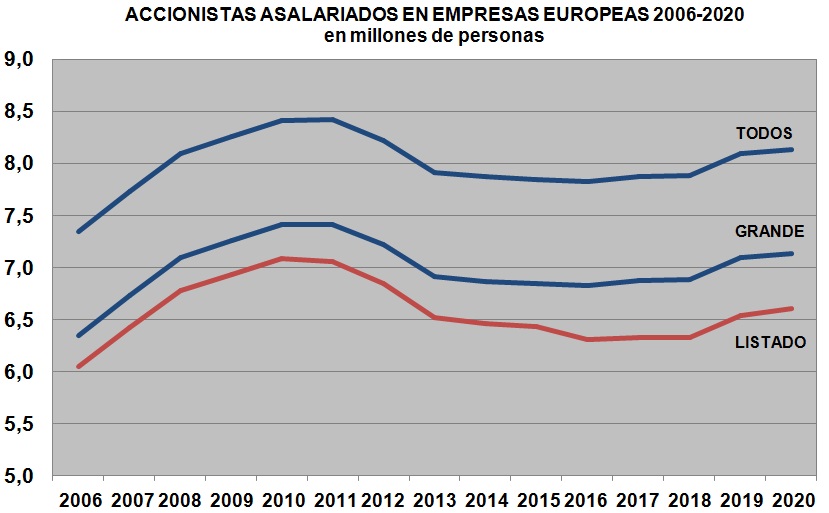
El
número de accionistas asalariados en Europa
sigue aumentando.
Esto es lo que muestran las primeras cifras
del nuevo Censo Anual del Accionariado Asalariado
en Europa, que se publicará el próximo mes
de abril.
El gráfico permite distinguir entre la evolución
en las empresas que cotizan en bolsa, pero
también en el conjunto de las grandes empresas
(cotizadas y no cotizadas) y de las PYME.
|
|
En
las grandes empresas, el accionariado asalariado
ha sufrido las políticas negativas adoptadas
por los gobiernos de países como Francia o
Dinamarca a principios de la década de 2010.
Recientemente, las políticas han vuelto a
ser más positivas, pero los impactos negativos
aún están lejos de ser superados. Es más fácil
quebrantar la confianza que recuperarla. En
Dinamarca, por ejemplo, los incentivos fiscales
se suprimieron en 2011 y se restablecieron
en 2016, pero pocas de las empresas que han
suspendido sus planes de accionariado asalariado
se han arriesgado aún a reinvertir en ellos.
En las PYME, el número de accionistas asalariados
en Europa sigue estancado en torno al millón
de personas. Aparte de Gran Bretaña, ningún
país europeo ha creado hasta la fecha un régimen
de accionariado asalariado adaptado a las
PYME (salvo las cooperativas de trabajadores
y las sociedades laborales). No se puede comparar
con los Estados Unidos, donde sólo los planes
ESOP cuentan con 14 millones de empleados
accionistas.
Al ritmo actual, Europa tardará algo más de
400 años en alcanzar un número de accionistas
asalariados comparable al que se alcanza hoy
en Estados Unidos.
¡Vamos, podemos hacerlo mejor!
|
|
Enero
2021 - Accionariado asalariado en las PYMES
- El ejemplo de Gran Bretaña
|
|
Es
bien sabido que el traspaso de una empresa
es el momento más favorable y la operación
más eficaz para aumentar el accionariado asalariado
en las PYMES.
Esto
es lo que convenció a los EE.UU. para implementar
la técnica del plan ESOP en 1974. En
Europa, el primer país que actuó en la misma
dirección fue Gran Bretaña, con el lanzamiento
de la fórmula del “Employee Ownership Trust”
(EOT) en abril de 2014.
Pregunta:
¿Ha resultado un éxito?
-
De
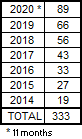
19 traspasos en 2014, pasamos a 27 en
2015, luego a 33, 43, 56, 66 y finalmente
a 86 en los primeros once meses de 2020
(Tabla 1). Así, un total de 333 empresas
fueron transferidas a más de 30.000 accionistas
asalariados. Para alcanzar un número comparable
de accionistas asalariados, Francia ha
tardado más de cien años, gracias a la
fórmula de la cooperativa de empleados
(SCOP).
-
En
un gran número de casos, como en el plan
ESOP, se trata de transferencias del 100%
de las empresas a los empleados. En otros
casos, la transferencia es parcial.
-
El
tamaño medio de las empresas transferidas
es de 91 empleados, lo que es muy representativo
del tamaño de la PYME media. En un pequeño
número de casos, se trata de transferencias
de microempresas, con un tamaño medio
de 7 empleados. El tamaño medio de las
"pequeñas" empresas transferidas
es de 25 empleados, y el de las empresas
"medianas" es de 100 empleados.
Por último, el tamaño medio de las grandes
empresas que no cotizan en bolsa es de
806 empleados. Todas estas cifras están
muy en línea con el tamaño promedio de
las poblaciones de las empresas de todos
los tamaños. Por lo tanto, la fórmula
muestra un grado muy alto de adaptabilidad,
sin sesgo en el tamaño de las empresas.
-
Los
sectores empresariales en cuestión son
principalmente sectores de alto valor
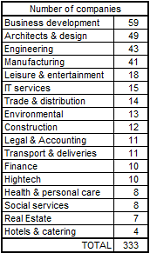
añadido y de tecnología de punta (Tabla
2). También en este caso, la amplia gama
de sectores empresariales es un signo
de la gran adaptabilidad de la fórmula.
|

|
|
En
resumen: ¡un éxito notable!
Gran
Bretaña es hasta ahora el único país europeo
que ha logrado adoptar una política eficaz
de accionariado asalariado en las PYMES.
Sin
embargo, podemos aún mejorar.
En
1980, pocos años después de su lanzamiento
en 1974, el plan ESOP ya había dado lugar
a unas 5.000 transferencias de empresas en
los EE.UU. En ese momento, las poblaciones
de Gran Bretaña y los Estados Unidos estaban
en una proporción de 1 a 3. A escala de Gran
Bretaña, el plan ESOP había posibilitado así
transferir un poco más de 1.500 empresas,
frente a las 333 transferencias de empresas
observadas hoy en día con la fórmula EOT.
¿Por qué esta diferencia de eficacia entre
las dos fórmulas?
La
fórmula EOT es un derivado simplificado del
plan ESOP. Parece que en este caso, como sucede
a menudo, el original es mejor que la copia.
De
hecho, hay dos diferencias principales entre
ESOP y EOT:
1.
La fórmula EOT se basa en la exención de impuestos
sobre los dividendos (distribuidos como bonificaciones
a los empleados, exentos de impuestos hasta
3.600 libras esterlinas anuales), en virtud
de una legislación especial. En
comparación, el plan ESOP permite la exención
no sólo de los dividendos sino también de
los propios beneficios de la empresa. Por
lo tanto, la fórmula ESOP evita tanto el impuesto
sobre la renta como el impuesto a los dividendos.
Esto no ocurre en virtud de ninguna legislación
en particular, sino en virtud de la simple
ingeniería fiscal del accionariado asalariado.
2.
En la fórmula ESOP, los empleados pueden cobrar
sus acciones y venderlas cuando abandonan
la empresa (normalmente en el momento de la
jubilación). En la fórmula EOT, no lo pueden
hacer, el fideicomiso mantiene las acciones
por un período indefinido de tiempo, a perpetuidad.
Estas
dos diferencias probablemente explican el
éxito mucho mayor del plan ESOP.
Sin
embargo, hoy en día existe un debate mundial
sobre las respectivas ventajas de las dos
fórmulas. ¿ESOP o EOT? El tema está sobre
la mesa en Gran Bretaña, así como en los Estados
Unidos, Canadá y Australia.
¡Dos
fórmulas son mejores que una! En los EE.UU.
podría ser conveniente añadir la fórmula EOT
al modelo ESOP existente. Y en Gran Bretaña
seguramente tendría sentido introducir la
fórmula ESOP además de la EOT.
En
ambos casos, debería ser fácil dejar la elección
de la fórmula a los nuevos accionistas. Una
vez establecido el fideicomiso, la elección
de la fórmula se dejaría en manos de los nuevos
accionistas, lo que permitiría implementarlo
ya sea en forma de ESOP o EOT. No hay duda
de que el accionariado asalariado encontraría
aún más legitimidad y apoyo.
Para
saber más
|
|
Diciembre
2020 - Ingeniería fiscal
|
|
¿Qué
empresa no sueña con duplicar su rentabilidad?
Esto
es lo que el plan de accionariado asalariado
ESOP permite lograr en la mayoría de los países
europeos, dependiendo de los tipos de impuestos
sobre la ganancia y los dividendos corporativos.
Es
bien sabido que cada tipo de empresario tiene
sus propias formas particulares de ingeniería
fiscal. Ya sea el gran grupo empresarial internacional,
el propietario individual o la empresa familiar,
todos tienen sus propios métodos.
Sin
embargo, se suele ignorar que el accionariado
asalariado proporciona mecanismos particularmente
eficaces para las PYMES.
Por
tanto, el sistema fiscal existente fomenta
la participación del accionariado asalariado
y la reducción de las desigualdades de riqueza.
Y esto sin ninguna nueva legislación en particular.
Esta particularidad es la base del éxito de
los planes de accionariado asalariado ESOP.
En
efecto, el plan ESOP permite disponer de la
ganancia de la empresa en forma de contribuciones
de pensión complementaria para los empleados-propietarios
de la empresa. Una vez que se ha dispuesto
de la ganancia, ya no hay impuestos sobre
la ganancia o sobre los dividendos. Es tan
simple como eso.
Esto
es lo que hace que el plan ESOP sea más simple
y más eficaz que cualquier otro para el accionariado
asalariado en las PYMES y para proporcionarle
capital social. Esta
ha sido una de las dos claves del éxito de
los planes ESOP en las PYMES en los EE.UU.
desde 1974.
Por
eso hay 14 millones de accionistas asalariados
en los planes ESOP en los EE.UU., en comparación
con apenas un millón de accionistas en las
PYMES en Europa, a pesar de que la población
de los EE.UU. es la mitad de la nuestra.
La
ingeniería fiscal es a menudo criticada. En
muchos casos, permite reducir los impuestos
para beneficiar los intereses privados a expensas
del interés público.
Con
la ingeniería fiscal del accionariado asalariado,
pasa algo totalmente diferente. Esta beneficia
a todos los empleados y al interés público.
De hecho, todos los estudios muestran que
contribuye al bienestar general y a la reducción
de las desigualdades.
La
ingeniería fiscal del accionariado asalariado
es una ingeniería fiscal virtuosa.
Para
saber más
|

|
|
Noviembre 2020
- Cómo crear un plan ESOP
|
|
Para
el accionariado asalariado en las PYMES, el
ESOP es el plan más simple y eficaz del mundo.
Así es como se hace:
1. Usted es el principal accionista de la
empresa XYZ y quiere vender sus acciones.
2. Crea una “Fundación para la propiedad de
acciones y pensiones de empleados en la empresa
XYZ”.
3. Vende sus acciones a la fundación. Para
el pago, otorga un crédito a la fundación
(o le ayuda a obtener crédito u otra financiación).
4. Al año siguiente, como todos los años,
la empresa XYZ obtiene una ganancia. Esta
solía estar gravada. Ahora ya no es así. La
empresa calcula y paga a la fundación una
contribución para la pensión equivalente a
la ganancia antes de la participación de los
empleados. A partir de allí, la ganancia desaparece.
Sin ganancia, no hay impuestos.
5. La fundación recibe la contribución anual
para las pensiones. Es una organización sin
fines de lucro, por lo que no se gravan sus
ingresos. Tampoco hay impuestos allí.
6. La fundación crea una cuenta individual
para cada empleado. En ella se registran los
derechos de cada empleado a recibir acciones
de la empresa XYZ cuando deja la empresa (normalmente
a la edad de jubilarse).
7.
Además, la fundación organiza un sistema para
que los accionistas asalariados voten sobre
los puntos del orden del día de la reunión
anual de accionistas de la empresa XYZ.
8. Cada año, la fundación recibe la contribución
de pensión complementaria de los empleados
que son miembros del plan. Esta contribución
se utiliza en primer lugar para devolver el
crédito originalmente recibido para la compra
de las acciones.
9. Luego, las acciones libres de reembolso
se transfieren anualmente en forma de “derechos”
a la cuenta individual de cada empleado, utilizando
una simple clave de distribución (a menudo
a prorrata de los salarios).
10. Así pues, los empleados ejercen sus derechos
como accionistas y son propietarios de las
acciones, con la salvedad de que sólo pueden
disponer de ellas (venderlas) cuando dejan
la empresa. Están muy motivados para hacer
que todo funcione para bien. De hecho, se
ha observado que las empresas con planes ESOP
funcionan mejor que otras.
Un plan ESOP es así de simple.
Download
|

|
|
Octubre
2020 - Incluso en Francia
|
|
14 millones de accionistas asalariados en
el modelo ESOP sólo en los EE.UU. Millones
de accionistas asalariados en PYMES allí,
casi nada aquí. Prosperidad para ellos, migajas
aquí.
¿Pero qué es lo realmente americano del modelo
ESOP?
Un Management Buy Out (MBO) ¿es americano?
Ciertamente no, se trata de finanzas, es universal.
Incluso en Francia.
Una compra apalancada (LBO) ¿es americana?
Ciertamente no, se trata de finanzas como
que dos y dos son cuatro, es universal. Incluso
en Francia.
Un fondo o una fundación para tener acciones
en nombre de los empleados ¿es algo americano?
Ciertamente no, es universal. Incluso en Francia.
Un accionista que vende todas o parte de sus
acciones a una fundación ¿es americano? Por
supuesto que no, eso se hace en todas partes.
Incluso en Francia.
Los suplementos de pensión deducibles de las
ganancias corporativas ¿son americanos? Ciertamente
no, se ven en todas partes. Incluso en Francia.
Una fundación en la que las acciones en nombre
de los empleados sólo están disponibles cuando
los empleados dejan la empresa, ¿es una fundación
americana? Véase Austria, incluso en empresas
muy grandes como Voestalpine o Erste Bank.
Véase Suecia... ¿Es posible aquí? Claro que
sí. Incluso en Francia.
|

Superdupont
|
|
Entonces, estos son los principales ingredientes
del modelo ESOP.
Todo esto es posible también en Europa. Sin
legislación especial, con la ley vigente.
Incluso en Francia.
Recordamos que nuestros amigos de Equalis
Capital en París anunciaron hace unos años
con justo orgullo una primicia, un modelo
ESOP francés (del tipo no apalancado, es cierto).
Entonces, ¿cuándo se lanzará en Francia el
primer modelo ESOP apalancado?
La parte estadounidense del modelo ESOP es
una cosa y sólo una: ellos lo usan y nosotros
no. No es lo mismo. ¿Dejaremos algún día esta
tontería y comenzaremos a usar el modelo ESOP?
¿Incluso en Francia?
¿Cómo
puede introducirse este tipo de plan de accionariado
asalariado en todos los países europeos? Un
grupo de expertos europeos y americanos lo
explican en
esta publicación.
|
|
Settiembre 2020 - Toda
una biblioteca
|
|
El
ESOP es el plan de accionariado asalariado
más conocido del mundo. Es tan emblemático
que se describe como “el” plan de accionariado
asalariado (“the” Employee Stock Ownership
Plan, lo que también trajo algo de confusión).
Ningún
otro modelo involucra a tantos empleados accionistas
(14 millones en los EE.UU.). Desde su lanzamiento
en 1974 llamó la atención de los más famosos
expertos e investigadores en materia del accionariado
asalariado.
Todos
los años, estos expertos se reúnen en San
Diego, California, incluyendo a muchos europeos.
Es el tema de la mayoría de los trabajos de
investigación y académicos sobre el accionariado
asalariado en todo el mundo.
Y
es el programa de accionariado asalariado
más eficaz y el más exitoso para las PYMES.
Una
biblioteca especializada cuenta con más de
600 trabajos destinados a apoyar la enseñanza
y la investigación sobre el accionariado asalariado.
Toda la información sobre la Biblioteca CLEO
se encuentra aquí.
¿Cómo
podemos introducir este tipo de plan de accionariado
asalariado en cada país europeo? Un grupo
de expertos europeos y estadounidenses lo
explica en
esta publicación.
|

|
|
Julio
2020 - Accionariado asalariado para PYMES
|
|
A nivel mundial,
existe un modelo de plan de accionariado asalariado
para PYMES mil veces más eficaz que todos
los demás. Es el plan ESOP. Es muy adecuado
para los propietarios de PYMES, así como también
para los empleados.
¿Por
qué? Porque se basa en las técnicas financieras
actuales, y no en las de siglos pasados.
En
este modelo, los empleados no tienen que encontrar
el dinero, sacrificar sus ahorros, correr
el riesgo. En efecto, tal como podemos ver
en las técnicas de compra apalancada, son
la empresa y sus accionistas los que proporcionan
la financiación y las garantías.
¿Cómo podemos introducir este tipo de plan
de accionariado asalariado en cada país europeo?
Un grupo de expertos europeos y estadounidenses
lo explica en
esta publicación
|
|
|
Junio 2020 - Las tres ramas
del accionariado asalariado
|
|
Debemos tener claro
en Europa que la participación accionaria
de los empleados no es un modelo único; de
hecho, hay tres modelos principales de planes
de participación accionaria para empleados.
1) Planes de compra de acciones para empleados
(ESPPs = Employee Share Purchase Plans).
En este modelo, los empleados compran acciones
de la empresa para la que trabajan, generalmente
a un precio de descuento. Los planes ESPP
son los más efectivos para las grandes empresas
que cotizan en bolsa.
2) Opciones de compra de acciones, que son
los planes más efectivos para las empresas
de reciente creación (startups).
3) El modelo ESOP. Es algo completamente diferente
a los dos primeros modelos y es el plan de
participación accionaria para empleados más
efectivo para las PYMES. En este modelo, los
empleados se convierten en el propietario
colectivo de la empresa para la que trabajan.
Para esto no tienen que usar sus propios recursos
o ahorros. La financiación suele provenir
de fuentes externas, normalmente bancos (como
en una compra apalancada) u otras fuentes
como en el contexto de la crisis del coronavirus.
Por lo tanto, los primeros beneficiarios de
los planes ESOP no son los empleados sino
las empresas. En los EE.UU., esta es una forma
significativa de financiar toda la economía.
El modelo ESOP puede ayudar a las empresas
a hacer frente a los problemas de liquidez
y quiebras, donde los empleados serán los
beneficiarios finales, por eso se trata de
un plan de participación accionaria de los
"empleados".
Echemos un vistazo a Europa en lo que respecta
a estos tres modelos diferentes.
1) Los planes de compra de acciones para empleados
(ESPP) son bien conocidos en Europa: Varios
países europeos han promovido estos planes
durante mucho tiempo y con éxito. Están destinados
principalmente a las aproximadamente 10.000
empresas europeas que cotizan en bolsa y que
emplean a 36 millones de trabajadores o el
25% de los empleados de las empresas privadas
europeas.
2) Opciones de compra de acciones. La Comisión
Europea acaba de lanzar una nueva estrategia
para fomentar las opciones de compra de acciones
de los empleados para las startups.
Sin duda, un importante paso hacia adelante.
Se centra en las aproximadamente 18.250 empresas
europeas de reciente creación, que emplean
a decenas de miles de trabajadores o el 0,1%
de todos los empleados de empresas privadas.
3) ESOPs. Este modelo está destinado esencialmente
a las PYMES (y a las grandes empresas que
no cotizan en bolsa). Calculamos que hay 1,7
millones de PYMES en Europa que emplean a
54 millones de personas o el 37% de los empleados
en empresas privadas, e incluso 67 millones
o el 46% si contamos las grandes empresas
que no cotizan en bolsa.
Aún hoy en día, la participación accionaria
de los empleados en las PYMES europeas es
prácticamente desconocida. Ha tenido mucho
éxito durante 45 años en los EE.UU., por lo
tanto el modelo ya existe – el ESOP. Las PYMES
europeas se están perdiendo mucho, y podría
ser una herramienta importante para ayudar
a hacer frente a la crisis. La Comisión Europea
ha hecho un buen progreso en lo que respecta
a las opciones de compra de acciones para
empresas de reciente creación. Instamos a
que se hagan esfuerzos similares para los
planes ESOP en las PYMES. Las cifras implicadas
son mucho más altas. Más
información
|

|
|
Abril 2020 - Pandemia
|
|
Febrero 2020 - Contrasts
in the UK |
|
No this is not about
Brexit.
Six new firms moved last month to the Employee
Ownership Trust scheme, the highest number
in a single month since the scheme was introduced
into British law in 2014. Like the ESOP plan
in the USA from which it is loosely inspired,
the scheme aims to encourage the transmission
of SMEs to employees.
On the other hand, while presenting itself
as the best example for employee share schemes
in the UK and employee ownership as the key
point of its strategy, John Lewis department
stores chain today faces the biggest crisis
in its 156-year history.
See press review for all details.
|
|
|
Enero 2020 - France: On the way for the 10% |
|
France decided last year to reach a
10% employee shareholding target in French
economy by 2030.
This basically means doubling the current
level in large listed companies.
On the other hand, everything remains to be
done in French SMEs.
Very ambitious objective!
A working group of experts is now proposing
the set of 13 "strong and disruptive"
measures to reach the target. More
details
|
|
|
Noviembre 2019 - Employee share
ownership in SMEs
|
|
Employee
share ownership cannot be effectively developed
in SMEs by applying the same schemes as for
large companies. Large companies have to raise
more capital, they have to multiply the number
of shareholders in this view, and it makes
sense to involve many employee shareholders
as well. In SMEs, the need for capital is
limited, shareholders are few, and most often
it does not make sense to allocate shares
to many employees. In SMEs, collective employee
share ownership schemes are far more efficient
and, worldwide, the ESOP plan adopted in 1974
in the US is by far the most efficient of
all.
The United Kingdom is the only country in
Europe to have introduced employee share ownership
schemes for SMEs with some success (but much
less than in the US). For its part, the Labour
Party has also made a proposal under the label
of "employee ownership", which
is controversial.
On the other hand, employee share ownership
in SMEs, whether individual and direct as
in large companies raises the question of
devices to be able to exchange shares, as
can be done on a stock market. In the US,
the OTC Markets Group is pushing
for this.
|
|
| Octubre
2019 - Employee share ownership impacts top
executives compensation |
|
A research project at the University of Aix-Marseilles
in France highlights the impact of employee
share ownership on the level of compensation
of top executives in listed companies.
Employee share ownership affects the organization
of work, policies and management practices,
leading ultimately to an impact on corporate
performance.
The results of the study show that employee
share ownership plays a direct and indirect
role on the determinants of executive compensation,
with a significant moderating impact.
In addition, the presence of employee shareholders
directors on the Board of Directors tends
to limit executive compensation.
More information (in French)
|

|
| June
2019 - The
USA is widening the gap |
Studies are proliferating about employee share
ownership in the US, bringing useful information
for everyone in the world, including Europe.
The 2018 administration of the US General Social
Survey, a long-standing survey of the US work
force, included a segment on employee ownership.
It found that 20% of private-sector workers
in the USA have some level of ownership in the
companies where they work, including 11 million
who participate in ESOPs and 25 million with
some other form of stock-based compensation.
This is 36 million in total compared to 9 million
in Europe.
The survey found that among those workers that
hold company stock, the average value of that
stock was $75,205.
In total $2,700 billion compared to 400 billion
€ in Europe.
The study's author, professor Douglas Kruse,
noted that employee-owners are "six times
less likely to be laid off." The study
found that, over the last year, the surveyed
non-employee-owners were laid off at a rate
of 3.7%, versus 0.6% for the employee-owners.
Among companies with employee engagement programs,
the study found that companies with generous
employee ownership plans had a rate of turnover
in general (i.e., including voluntary turnover)
of 6%, far less than the 14% rate for those
with no stock plan.
This reality is far from the idea which was
prevailing in the Juncker Commission in Brussels,
that employee share ownership would be too risky
and bringing additional uncertainty to workers.
The truth is that employee share ownership brings
more wealth and stability. More
information |
|
| March
2019 - Congratulations
from the Irish Parliament |
|
The
Irish Parliament likes this newsletter, he
let us know by letter.
Every month, this newsletter highlights the
significant facts of employee share ownership
worldwide, as well as European policies.
The monthly press review is a fabulous source
of information. It sheds light on proven facts
and helps sort out fake news, delivering a
story full of novelties and twists.
The progress and benefits of employee share
ownership are becoming more and more evident.
Letter
from the Irish Parliament
|
|
|
Décembre
2018 - Appel des start-up européennes
Les
start-up européennes lancent un appel aux
politiques pour revoir les règlementations
de l'actionnariat salarié, afin de les mettre
à armes égales avec leurs concurrents de la
Silicon Valley.
L’Europe pourrait être le continent le plus
entreprenant au monde. Mais les règles qui
gouvernent l'actionnariat salarié en Europe
sont généralement archaïques et très inefficaces.
Elles
sont souvent si incohérentes et punitives
qu'elles constituent un obstacle majeur pour
le développement des start-up...
Plus d'information
|
|
| Novembre
2018 - Vote du Parlement Européen |
|
La Résolution du Parlement a été votée à une
écrasante majorité le 23 octobre à Strasbourg
(589 pour, 39 contre et 10 abstentions).
C'est
la conclusion du Rapport dû à Madame Renate
Weber, roumaine Membre du Parlement Européen
réaffirmant son soutien à l'objectif d'"actionnariat
salarié pour tous" et à un Plan d'Action
Européen.
Entre autres bénéfices de l'actionnariat salarié,
le Rapport a particulièrement souligné l'effet
positif de l'actionnariat salarié sur la croissance
et sur l'emploi.
Aux côtés d'autres Membres du Parlement, de
candidats à l'Election de 2019 et de Commissaires
européens, Madame Renate Weber sera à la conclusion
de la Conférence du 6 février à Bruxelles.
Plus
d'information
|
|
| October
2018 - Employee
share ownership? Which one? |
|
How
to make employee share ownership really work?
If there is one thing that absolutely everyone
believes in the UK, it is that employee share
ownership is a very good thing. However,
the new proposals due to the Labour Party
provoke violent controversies.
What
really matters is not just the shares but
the rights, obligations and extent of ownership
attached to them. Full rights or imitations?
In the Labour Party version, "employee"
ownership would not really be an ownership
scheme: Employees would not be able to buy
or sell the shares that would be notionally
theirs...
|
|
|
September
2018 - Legislative
proposal in Germany
|
|
North Rhine-Westphalia Government wants to
make employee ownership in start-ups much
more attractive in Germany through higher
tax incentives. A legislative proposal in
this sense is submitted to the Bundesrat.
The
current tax incentive would be increased from
360€ as it is now in Germany to 5.000€ annually.
This way, Germany would be at a standard level
for such incentives in Europe.
A European wave to promote employee ownership
and stock options in start-ups can be observed
in Europe recently. New legislation in this
sense are already in force in Ireland, France,
Sweden and the Netherlands, and projects are
also in discussion in Austria, Luxembourg
and Switzerland.
More
information
|
|
|
September
2018 - President
Donald Trump
|
|
President Donald Trump signed historic new
law bringing new incentives to promote employee-owned
businesses. It is known as the "Main
Street Employee Ownership Act".
The
new legislation had co-sponsors on both sides
of the political aisle, Democrats and Republicans.
It
is the most far-reaching employee share ownership
legislation to pass US Congress in over 20
years.
It is expected to double or even triple the
growth rate of employee-owned companies over
the next decade. More
information
|

|
| Juin
2018 - Baromètre des politiques
d'actionnariat salarié dans les pays
européens |
|
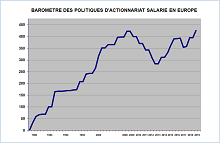
En 2018, 20 pays européens ont des politiques
de promotion et de développement de l'actionnariat
salarié, contre 18 en 2017 et 15 en 2015.
D'où un nouveau sommet historique pour notre
baromètre.
L'Autriche, la France, l'irlande, les Pays-Bas,
la Suède, le Danemark ont tous introduits
de nouvelles dispositions incitatives cette
année.
La France - pourtant déjà numéro un en Europe
- a pris la décision de doubler son actionnariat
salarié d'ici 2030, ce qui la mettrait au
niveau atteint aujourd'hui aux Etats-Unis.
Un signal fort pour tous les Européens.
Plus d'information
|
Télécharger
|
|
Juin
2018 - La Réserve Fédérale
Américaine sur l'actionnariat salarié |
|
Dans
une série d'articles sur la qualité du travail,
la Banque de Réserve Fédérale de Boston publie
un long article sur l'actionnariat salarié,
montrant comment il bénéficie aux entreprises,
aux travailleurs et aux économies locales.
L'article
comporte une interview du Professeur Douglas
Kruse de la Rutgers University qui retrace
le contexte et les résultats de recherches
sur l'actionnariat salarié et les plans ESOP,
ainsi qu'une interview de plusieurs actionnaires
salariés de Cape Air, y compris une vidéo
sur l'actionnariat salarié de l'entreprise.
Plus
d'information
|

|
|
May
2018 - Discriminations in voting rights
|
|
As
long term investors, employee shareholders
benefit from positive discrimination in France
since 2014: Voting rights are usually doubled,
which means that when employee shareholders
hold for instance 6%, their voting rights
count for 12%. This contributes to the growing
involvement of employee share ownership in
corporate governance in France. Employee shareholders
are represented in the Boards of Directors
in 33 of the largest French companies.
At the contrary, employee shareholders' voting
rights suffer negative discrimination in six
European countries: Denmark, Sweden, Finland,
The Netherlands, Switzerland and Germany.
Typical cases here are companies issuing two
classes of shares, A-shares with 10 votes
and B-shares with 1 vote. Controlling owners
hold high voting shares but employee share
plans are based on low voting ones. This way,
employee shareholders' voting rights are severely
discriminated, in up to 37% of large companies
in Sweden. Employee shareholders' voting rights
are generally reduced by 30% to 60% in Denmark
and Sweden, in comparison with the one-share-one-vote
rule. More
|
|
Avril 2018 - L'effet
"participation" sur la santé publique |
|
Dans
la Revue Esprit, Patrick Guiol revient sur
les résultats de recherches menés il y a peu,
faisant apparaître l'énorme potentiel d'économies
de l'effet "participation" pour
le budget de la sécurité sociale. Plus
|
|
|
Febrero 2018 - Les plus remarquables
cas en Europe
La
liste des cas les plus remarquables
de l'actionnariat salarié dans les grandes
entreprises européennes vient d'être
mise à jour. Elle identifie 113 cas
particulièrement remarquables en 2017.
Ceux-ci sont localisés en Autriche,
Belgique, Suisse, Danemark, Allemagne,
Espagne, Finlande, France, Hongrie,
Irlande, Italie, Pays-Bas, Norvège,
Suède et Royaume Uni. La liste des cas
remarquables est tirée du "Recensement
Economique Annuel de l'Actionnariat
Salarié dans les Pays Européens en 2017",
à paraître en mars prochain. La
liste complète
|
|
Enero 2018 - 10% in the hands of employees
in France |
|
The
objective of 10% to be held by employee
shareholders in France by 2030 was launched
last month in Paris by the French Federation
of Employee Shareholders Associations
(FAS).
This may be compared with 4 to 6% held
now in large French companies (depending
on definitions), and to some 10% in
the USA.
President Macron and the French Government
will back this objective, seeing employee
share ownership as a key factor for
the revival of a population of individual
investors.
After eight years of negative policies
under Presidents Sarkozy and François
Hollande, this is a very good signal
for employee share ownership in Europe.
France is back !
|
|

|
Diciembre
2017 - Good
news for employee share ownership in Europe |
|
As
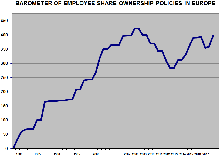
all barometers, this one announces the
future. The positive trend of our barometer
since 2013 announced the resumption
of growth in the number of employee
shareholders in European companies.
This one is actually happening. Very
good news for all Europeans !
All recent policy developments in Europe
pave the way towards higher incentives
for employee ownership, which confirms
the positive trend observed since 2013.
In
addition to the two existing employee
share schemes in Austria, a third
scheme will be introduced on 1.1.2018
providing exemption of tax and social
contribution up to 4.500 € annually.
In France, the employers' social
contribution on restricted share units
will be reduced in 2018. New legislation
in 2018 also in Ireland, in
The Netherlands, in Sweden.
In addition, Poland is preparing
promising legislation.
Twenty European countries now have incentive
policies for the development of employee
share ownership. This number had never
been higher before. More
information
|
|
|
Noviembre
2017 - What's going on with the European
Commission |
|
The
main obstacle to the development of
employee share ownership across Europe
is the lack of information about its
benefits and how manage risks.
In
a letter to European Commissioner it
is recalled that the Commission is committed
to launch a European information plan
to raise awareness in this sense. A
section on the promotion of employee
share ownership has also been added
to the Capital Markets Union Action
Plan.
However,
when it came time to vote on a budget
to materialize, some surprising objections
have emerged within the Commission.
The
letter to Commissioner Marianne Thyssen
calls on the Commission to fulfill its
commitments. More
|
Marianne
Thyssen
|
|
Octobre
2017 - Une
grande idée pour les réformes fiscales |
|
Il
est temps de faciliter beaucoup plus
l'accès des plans d'actionnariat à tous
les salariés. Réformer
l'impôt des sociétés de manière à assurer
aux salariés leur juste part. C'est
un credo de l'histoire américaine. A
Washington, le Congrès a pour l'instant
sur la table une demi-douzaines de nouvelles
propositions de législations pour l'actionnariat
salarié. Elles contiennent toutes des
éléments propres à faire tourner l'économie
mieux et plus équitablement.
"Notre
message clé est que tout avantage fiscal
donné aux entreprises devrait être subordonné
à un élargissement de l'actionnariat
des salariés". Voilà
le message répété en boucle par les
Professeurs Joseph Blasi, Douglas Kruse
et Richard Freeman, mondialement réputés
pour leurs travaux de recherches sur
l'actionnariat salarié. Plus
|

|
|
Setiembre
2017 - L'actionnariat salarié
contribue-t-il au rallye boursier en Chine?
|
|
C'est
la question posée par le National
Center for Employee Ownership (Californie)
dans sa dernière édition. La
montée des actions cotées à Shanghai
est à un plus haut depuis 20 mois, et
les analystes citent les réformes de
la propriété en Chine comme base de
la confiance des investisseurs.
Dans
le China Daily, Gao Ting, analyste en chef pour la Chine chez
UBS Securities, a signalé les réformes
mises en place par China Unicom, le
deuxième plus grand fournisseur local
de téléphonie mobile, avec une diversification
du conseil d'administration et un plan
d'actionnariat salarié. Le
sentiment positif est encouragé par
les signes d'accélération des réformes
du régime de propriété des entreprises
d'Etat.
|

|
|
Julio
2017 - L'exemple
autrichien |
|
La
législation pour l'actionnariat salarié
en Autriche est des plus simples. Jusqu'à
présent, tout avantage d'un plan
d'actionnariat reçu par un salarié (sous
forme de rabais sur le prix d'achat
des actions, d'abondement, d'actions
gratuites, etc.) jusqu'à 1.460 Euro
chaque année était libre d'impôt.
Ce
montant a doublé en 2016, pour passer
à 3.000 Euro par an.
Voilà
sans doute le meilleur exemple en Europe
du module de base pour l'actionnariat
salarié, dans la conception modulaire
d'une législation.
C'est
pourtant ce module le plus simple, le
plus élémentaire, qui a permis à Voestalpine
(50.000 salariés, la sidérurgie autrichienne,
15% détenus par les salariés) de faire
de l'actionnariat salarié un facteur-clé
de sa réussite.
Quel
contraste avec d'autres dans la sidérurgie
européenne, les Arcelor, les Florange,
les Cockerill !
Le
Gouvernement autrichien (grande coalition
entre Démocrates Chrétiens et Sociaux
Démocrates) vient de décider de porter
le montant libre d'impôt à
4.500 Euro par an.
Cependant,
cela se fera dans une nouvelle formule:
au lieu d'actions détenues en
direct, individuellement, cela devra
se faire sous forme collective, au moyen
d'une Fondation d'Actionnariat Salarié
(Mitarbeiterbeteili-gungsstiftung),
comme chez Voestalpine.
Beaucoup
d'entreprises autrichiennes, même parmi
les plus grandes, ont déjà fait savoir
qu'elles étaient prêtes à y aller.
|

|
|
Junio
2017 - Barometer of employee ownership
policies in European countries |
|
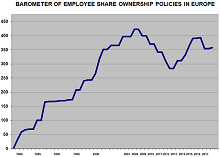
Eighteen European countries now have
policies for the promotion and development
of employee ownership. This number had
never been higher before.
Except in France, all recent policy
developments in Europe pave the way
towards higher incentives for employee
ownership. Norway doubled fiscal incentives
on 1.1.2017. Poland prepares dedicated
legislation. Ireland announces a new
share incentive scheme for SMEs to be
introduced in 2018, as well as The Netherlands
with a favorable tax treatment of stock
options for employees of innovative
start-ups. These
new developments confirm the positive
trend observed since 2013.
On the other hand, hesitation dominated
in France, where the outgoing government
suppressed in 2017 the positive provisions
introduced by the Macron Law eighteen
months earlier. This explains the relapse
of the barometer in 2017.
The
negative political decisions of France
since 2009 unfortunately influence the
performance of the whole of Europe.
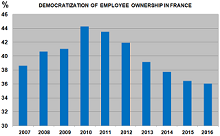
In France, they are at the origin of
the heavy fall in the rate of democratization
of employee ownership, the number of
employee shareholders being reduced
to three million compared with four
million with unchanged policy.
|
Download
|
Junio
2017 - Employee ownership and economic
well-being |
|
Employee Ownership —employees owning
stock in the companies where they work—is
a major aspect of the U.S. economy.
But until now, little research has explored
its impact on individual workers.
A new research on "Employee
Ownership and Economic Well-Being"
due to the NCEO in the USA presents
some of the first in-depth analysis
of the relationship between employee
ownership and workers’ economic well-being.
The findings of this research are remarkable.
Employee ownership is a market-friendly,
anti-inequality policy that improves
outcomes for companies and provides
workers with higher wages, more generous
benefits, and greater job stability.
In short: Employee-owners lose less
sleep over their financial future. More
information
|

|
|
Mayo 2017 - Deux fois moins de
licenciements |
|
Les
entreprises avec actionnariat salarié
ont licencié deux fois moins que les
autres au cours des deux dernières périodes
de récessions aux USA.
Une nouvelle étude dirigée par la Rutgers
School of Management avec le Professeur
Douglas Kruse met pour la première fois
en évidence un lien entre l'actionnariat
salarié et la plus grande stabilité
de l'emploi.
"Si on a pour objectif des emplois
stables et bien payés, alors l'encouragement
de l'actionnariat salarié dans les entreprises
a beaucoup de sens", conclut Douglas
Kruse.
"L'actionnariat salarié est souvent
considéré en premier lieu pour son effet
positif sur les relations de travail
et sur la productivité, mais nos résultats
montrent qu'il y a un important effet
dérivé sur la stabilité de l'emploi".
Plus d'information
|

|
|
Avril 2017 - Un pivot |
|
L'actionnariat
salarié doit être un élément pivot de
l'Union des Marchés des Capitaux, c'est
la position de l'Institut Allemand pour
l'Actionnariat (Deutsches
Aktieninstitut - DAI) en réponse
à la consultation publique organisée
par la Commission européenne. L'Union
des Marchés des Capitaux est un plan
de la Commission européenne pour mobiliser
le capital en Europe. "L'actionnariat
salarié est un facteur de stabilisation
pour l'économie européenne dans son
ensemble" affirme le DAI. "Les
études menées aux États-Unis montrent
clairement que les entreprises qui ouvrent
leur capital aux salariés créent
plus d'emplois que les autres. Les actionnaires
salariés accumulent plus de réserves
en vue de leur retraite, ont de meilleurs
salaires et sont moins susceptibles
de perdre leur emploi et devenir chômeurs.
Alors que les revenus des ménages dépendent
principalement du salaire, les actionnaires
salariés profitent aussi de l'augmentation
des revenus du capital, ce qui réduit
la distribution inégale des richesses
dans la société ". Plus
d'information
|
|
|
Avril 2017 - Plan d'Action Européen |
|
Dans
sa réponse à la consultation publique
sur l'Union des Marchés des Capitaux,
la Fédération Européenne de l'Actionnariat
Salarié souligne que l'Union Européenne
est fortement sous-développée par rapport
aux États-Unis pour ce qui est de l'actionnariat
salarié. Celui-ci contribue beaucoup
plus à la solidité et à la stabilité
des marchés de capitaux aux États-Unis
qu'en Europe. Le sous-développement
de l'actionnariat salarié handicape
aussi l'Europe en termes de productivité,
de croissance, de création d'emplois,
mais aussi en matières de retraites
et de transmissions d'entreprises, en
particulier pour
les
PME. Le Plan d'Action pour l'Union des
Marchés des Capitaux devrait affronter
ce handicap au moyen de deux décisions
particulières: Premièrement, un Plan
d'Action Européen pour l'actionnariat
salarié doit être mis en place pour
promouvoir la convergence européenne.
Deuxièmement, l'ignorance du modèle
ESOP est un handicap dramatique pour
l'Europe. De ce fait, l'actionnariat
salarié dans les PME est presqu'inconnu
en comparaison avec les États-Unis.
Le Plan d'Action doit remédier à cela.
Plus
d'information
|

|
| |
|
Février 2017 - Les cas remarquables
de l'actionnariat salarié en
Europe
La
liste des cas les plus remarquables
de l'actionnariat salarié dans les grandes
entreprises européennes vient d'être
mise à jour. Elle compte 114 cas particulièrement
remarquables en 2016, localisés en Autriche,
Belgique, Suisse, Danemark, Allemagne,
Espagne, Finlande, France, Hongrie,
Irlande, Italie, Pays-Bas, Norvège,
Suède et Royaume Uni. La liste des cas
remarquables est tirée du "Recensement
Economique Annuel de l'Actionnariat
Salarié dans les Pays Européens en 2016",
à paraître en mars prochain. Voir
la liste complète
|
Enero 2017 - Un
formidable moteur - encore et encore
La part détenue par les salariés dans les
grandes entreprises européennes poursuit sa
montée. Elle n'a jamais été aussi élevée,
à 3.20% en 2016 (voir graphique). Même à travers
la crise européenne, l'actionnariat salarié
démontre encore et encore son statut de formidable
moteur de participation et de développement.
Les avoirs par personne ont doublé depuis
2009. Voilà les toutes premières indications
à tirer du "Recensement de l'Actionnariat
Salarié dans les Pays Européens" qui
sera publié en mars 2017.
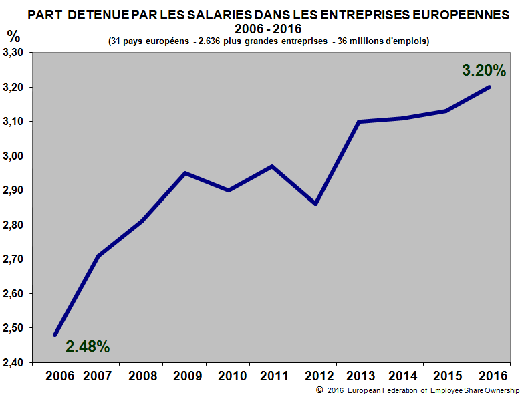
|

|
|
December 2016 - Barometer
of Employee Ownership Policies
The
new edition of the "Barometer of
Employee Share Ownership Policies in
European Countries" is just released.
Except in France, all recent policy
choices in Europe pave the way towards
higher incentives for employee ownership:
· Poland
prepares a dedicated legislation.
· The
Swedish government is considering the
introduction of a favorable tax-qualified
option regime for small and medium sized
companies, which could take effect from
January 2018.
· In
Ireland, a new share scheme incentive
focused on SMEs would be introduced
in 2018.
These new developments confirm the positive
trend observed since 2013. Most recent
policy decisions regarding employee
ownership in Europe are positive. More information
|
Octobre 2016 - El
Europarlamento edita un estudio sobre la sociedad
laboral como referencia de la participación
financiera de los trabajadores
El Parlamento Europeo edita un estudio sobre
la participación financiera de los trabajadores,
centrado en el modelo de la sociedad laboral
y con la participación como autores del informe
de Gemma Fajardo, profesora titular de Derecho
Mercantil de la Universidad de Valencia y
gran experta en el modelo de la sociedad laboral
y participada; Javier Muñecas, del departamento
jurídico de Asle y Javier San José, experto
asesor de Asle. Este estudio, encargado por
el Departamento de Política A para la Comisión
de Empleo y Asuntos Sociales de la eurocámara,
consta de tres sesiones de información que
presentan el marco legal para estas empresas,
así como estadísticas sobre su tasa de supervivencia
y la conservación del empleo, la opinión de
un académico del modelo y observaciones de
un experto del sector. Confesal destaca la
importancia de que el debate actual sobre
la participación en la UE, haya centrado su
atención en el modelo español de las sociedades
laborales. Leer
más
|
Octobre 2016 - All
is well in Paris
It is true that France is still number
one for employee share ownership in
Europe. All things are fine in Paris,
my fair lady.
However, what a drop since 2011! The
democratization rate of employee ownership
fell from 45 to 37% and the number of
employee owners in France returned to
3 million (instead of 4 million if policies
hadn't been changed).
The imposition of a specific tax on
employee share plans ("forfait
social") had a disastrous effect.
Not only in France but also by imitation
in several other European countries.
Denmark is exemplary, which removed
all fiscal incentives for employee share
plans in 2011 (with a new social democratic
government) to restore them fully in
2016 (with a new conservative-liberal
government).
A good example to make things even better
in Paris! More information
|

|
Octobre 2016 - Risk
and performance of employee share ownership
in France
ERES Group publishes outstanding results based
on the analysis of all broad-based employee
share plans in large French companies since
2006. After 5 years, employees having subscribed
to an employee share offering between 2006
and 2010 were winners in 82% of cases (with
the dividend, the discount and the average
employer contribution of 50%) while ordinary
shareholders would be winners in 60% of cases.
What confirms that employee ownership is to
be ranked into the category of "good
risks". More
information
|
Setiembre 2016 - Liberté
économique
Un travail de recherche remarquable
récemment publié met en évidence une
forte corrélation entre l'actionnariat
salarié et l'indice de liberté économique.
L'auteur, Ricardo Machado de la Porto
School of Management (Portugal),
cherche à comprendre les déterminants
de la mise en place de la démocratie
économique, mesurée par l'incidence
des plans d'actionnariat salarié dans
les pays de l'Union Européenne.
La publication complète sur "The
Determinants of Employee Ownership Plan
Implementation in EU Countries - the
Quest for Economic Democracy"
est disponible au téléchargement
ici.
|

|
|
Juin 2016 - Conférence
européenne sur les politiques d'actionnariat
salarié |
|
|
La Conférence européenne sur les politiques
d'actionnariat salarié s'est tenue à
Bruxelles le 19 mai 2016.
La Conférence soutient le projet de
Plan d'Action Européen destiné à sensibiliser
le public aux avantages de l'actionnariat
salarié en Europe.
Le Rapport final de la Conférence et
tous les documents sont à télécharger
ici
|
|
Juin 2016 - Baromètre
des politiques d'actionnariat salarié
dans les pays européens |
|
On
sait que le développement large de l'actionnariat
salarié est facteur de meilleure motivation,
de productivité, de rentabilité, de
croissance plus soutenue, d'emplois
plus nombreux et de meilleure qualité.
Tout cela est bon pour tout le monde.
Mais cela dépend de la volonté politique
d'amorcer le cercle vertueux au moyen
d'incitants fiscaux appropriés.
Après
2008, plusieurs pays européens ont pris
des décisions négatives, en réduisant
ou en supprimant les incitants fiscaux,
ce qui a conduit à une régression du
nombre d'actionnaires salariés.
D'autre pays ont fait le choix inverse,
celui d'incitants nouveaux ou plus importants,
d'où une croissance du nombre d'actionnaires
salariés.
Toutes ces décisions politiques dans
les différents pays, les unes négatives,
les autres positives, peuvent être synthétisées
au moyen d'un outil simple. C'est la
fonction du nouveau "Baromètre
des politiques d'actionnariat salarié
dans les pays européens".
Avant
2009, le baromètre des politiques européennes
indiquait une montée pratiquement ininterrompue,
les décisions politiques visant l'actionnariat
salarié étant généralement positives.
Une phase négative est intervenue de
2009 à 2013. Depuis, la plupart des
décisions politiques sont à nouveau
positives.
|
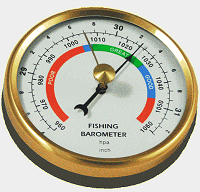
Plus
d'information
|
April 2016 - Employee
share ownership in SMEs
A first reliable study about employee share
ownership in French SMEs was published last
month. It is well known that employee share
ownership in SMEs is underdeveloped in Europe,
especially compared to the USA. This is due
to the remarkable effectiveness of the ESOP
model, in use in the USA for over 40 years,
but not in Europe. The usual evaluation of
the number of employee shareholders in SMEs
is 1 million in Europe compared to 10 million
in the US. The new study, ordered by Eres
and BDO, brings the number of 250.000 in France,
which confirms the former usual evaluations.
More
information
January 2016 - French
crusade
All actors of employee share ownership
in France met for their "Grand Prix"
on 15 December in Paris. They all agreed to
launch a new "crusade" for employee
share ownership in France. Several governments
in the European Union chose for higher fiscal
incentives, considering employee share ownership
as an investment for the future and a key
for recovering from the European crisis. So
did the UK and Austria recently. The example
is also coming from the USA, with employee
ownership being one of the themes of the presidential
election campaign. France should get back
to the same way.
January 2016 - Formidable
engine
Assets held by the employee owners in Europe
were never so high: 370 billion Euro and more
than 3% of the capital of all large European
companies in 2015. This is more than 45,000
€ per person (more than 25,000 € if executive
directors are excluded). Thus, even through
the European crisis, employee share ownership
is a formidable engine to share in results
and growth, - assets per person have more
than doubled since 2009. This is the first
indication from the next "Economic Survey
of Employee Share Ownership in European Countries"
to be published in March 2016. More
information

|
December 2015 - Employee
share schemes statistics provoke wide
debate in the UK |
The
latest published share scheme statistics
has sparked off a major debate over how
best to rejuvenate UK employee share ownership,
following the British ESOP Centre (see
press review). "The UK has perhaps
the best employee share plan legislation
in the world", but it is still far
from Mrs Thatcher aspiration, 30 years
ago, for a Britain where owning shares
would be "as common as having a car".
Now after 30 years of legislation in the
UK and in France, the facts have spoken:
Employee share ownership is twice more
significant in France; this is where the
employee share plan legislation was most
effective. This is probably due to the
fact that employee share plans in France
are based on (blocked) shares, while they
are essentially based on share options
in the UK. As we already mentioned some
time ago, after a spectacular football
match: France-UK:
2-1 |
|
|
Noviembre 2015 - Italian
Post: Missed opportunity |
The
Italian government offered 40% of the
shares of the Italian Post, on which 1.13%
reserved for employees. Results of the
IPO are very satisfactory for the Italian
State, collecting 3.4 billion euros, with
total demand exceeding 4 times the offer.
Employees have received half of the reserved
shares: 26,234 employees subscribed, less
than 20% of all employees of the Italian
Post. In an open letter, the CISL union
had put forward its own draft collective
ownership, combined with community representation
of employees on the German model. The
Italian Government did not want to go
that way, nor did it choose for a real
employee share ownership plan supported
through fiscal incentives. Yet will there
be IPO bonuses for 12 top executives,
up to half of their annual salary. Comparison:
The British Government put Royal Mail
on the stock market two years ago, while
awarding a 10% stake for free to the 150,000
employees of the British Post.
The
open letter of the CISL |
|
|
October 2015 - Employee
share ownership is not a cuckoo |
A
dangerous and irritating situation is
occurring about employee share ownership
within the OECD. The OECD suggests that
ESOPs and employee share ownership should
be discouraged because putting all employees'
eggs in the same basket, especially considering
pension savings. The principle of diversification
applies to employee share ownership as
to any other financial investment. It
is illustrated by the aphorism "do
not put all eggs in one basket."
However, employee share ownership is not
just a financial investment. It also has
the character of an industrial investment.
This character is most evident when the
employees' stake reaches 100% of the
company's capital, which is the typical
case of employee share ownership in SMEs.
However, it is also present, although
more incidentally, to the minority employee
share ownership in large companies.
If the aphorism of eggs and basket frequently
applies to the diversification of financial
investments, another aphorism applies
better to industrial investment: "The
bird lays all eggs in the same nest".
Among the few exceptions, the example
of the cuckoo is well known. It must be
said: Employee share ownership is not
a cuckoo. More information
|
|
|
Setiembre 2015 - 2.000.000.000
Euro to promote employee ownership |
Two
billion Euro: On the scale of Europe,
this is the estimated tax cost to the
US Federal Government for ESOP-specific
incentives in 2014 (US$ 1.9 billion).
By comparison, a new study was just published
on the impact of employee ownership and
ESOPs on layoffs and the costs of unemployment
to the Federal Government. The data show
that employee-owners are far less likely
to lose their jobs than non-employee-owners.
In turn, these low job losses saved the
Federal Government US$17 billion in 2014
alone, making clear that ESOP incentives
have been an excellent investment for
the taxpayer, for the Federal Government
and for the US economy as a whole.
This is exactly what we need in Europe
too: The same ESOP model, with the same
fiscal incentives, for the same macroeconomic
balance. The ESOP (Employee Stock Ownership
Plan) is the most effective model in the
world for employee ownership in SMEs.
It provides private owners with the best
way to sell their company to employees,
and for employees to become owners at
low risk. More
information |
|
|
June 2015 - German
politics finally needs to act |
Attention
has to be drawn to the recent call published
by the German Share Institute (Deutsches
Aktieninstitut).
Whereas in other European countries like
France (3.3 million employee shareholders)
and Great Britain (2.2 million) the numbers
of employee shareholders are counted in
millions, in Germany only 800.000 employees
benefit from employee share ownership.
In its call Deutsches Aktieninstitut therefore
demands of the governmental parties to
finally create higher tax incentives and
better regulation to promote employee
share ownership. Due to continuing low
interest rates Germans will neither be
able to maintain their savings nor obtain
a sufficient amount of money for their
retirement arrangements without more share
investment.
Employee share ownership is a good way
to get a first insight into saving with
shares.
However, the number of employee shareholders
is declining in Germany. In fact, it has
never been so small. Fiscal aspects play
a major role for the dissemination of
employee share ownership. If Germany really
wants to promote employee share ownership,
it needs to adapt its allowances to common
international levels and to increase it
strongly. More
information |
|
June 2015 - Call
from 10 major German organizations
Ten
major German organizations call for a new
German Agenda for employee share ownership.
More
information
|
May 2015 - Fiscal
policies for employee share ownership |
| This
is the map of European countries encouraging
employee share ownership. In blue, the
12 European countries supporting employee
share ownership through significant fiscal
incentives. This is a minority of Member
States in the European Union. However,
this minority of 12 Member States of the
EU represents the lion's share when considering
European listed companies, stock market
capitalization and employee share ownership:
72% of all European listed companies,
with 72% of employees, 77% of the stock
market capitalization, 83% of employee
shareholders. See
details in our new publication about
"Employee Share Ownership for Building
the Capital Markets Union". |
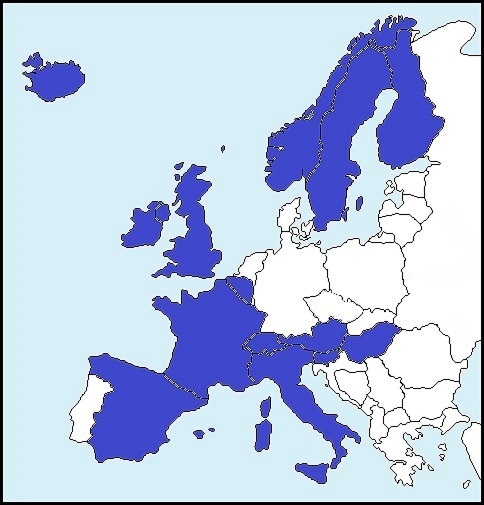 |
|
May 2015 - Capital
Markets Union |
 |
The
European Commission launched a Green Book
and a public consultation on "building
a Capital Markets Union".
It is remarkable that, together with the
European Federation of Employee Share
Ownership, several major organizations
representing the full range of private
actors of the Capital Markets Union converge
on analysis and proposals about employee
share ownership in Europe, as:
• EuropeanIssuers
• The
European Private Equity & Venture
Capital Association
• The
Federation of European Securities Exchanges
• Better
Finance, the European Federation of Investors
and Financial Services Users.
Details
|
21.04.2015:
Answering the European Commission’s Green
Paper on the Capital Markets Union, EuropeanIssuers,
the European Private Equity & Venture
Capital Association and the Federation
of European Securities Exchanges published
the
EU IPO Report: "Rebuilding
IPOs in Europe; Creating jobs and growth in
European capital markets".
The
Report points out the fact that the number
of employee shareholders was recently declining
in Europe. As the EFES evidenced, these changes
are clearly related to the regressive fiscal
policies in many European countries.
However,
European companies need investment, to grow,
to enter new markets, to develop new products
and to create jobs. A healthy European capital
market attracting long-term investors (especially
households, employees and pension savers)
is a critical route to channel such investment.
More generally, "the links between savers,
the original providers of capital, and the
financial markets, which allocate that capital,
have become less coherent".
The
Report recommends that policymakers set the
goal of creating an equity culture in Europe.
That Member States should be encouraged to
use tax policy to encourage long-term investing,
providing tax incentives to encourage investment
for the longer-term in equity. That fiscal
incentives should be provided to support the
development of employee share ownership across
Europe.
|
April 2015 - European
governments bet again on employee ownership |
| The
table of all recent policy decisions regarding
employee share ownership in European countries
reveals a remarkable shift. At the beginning
of the financial crisis, several countries
took negative decisions to reduce their
expenses, in a pure short term vision.
This bad signal came first from France,
followed by Greece, Denmark, Ireland and
The Netherlands, between 2009 and 2012. |
|
| Since
2012, most political decisions are positive
again, as in the UK, in Spain, in Hungary,
and in Austria where tax incentives will
be doubled. Details |
April 2015 - New
study finds ESOPs total return beats S&P
500 by 62%
A new analysis of the economic impact of S corporation ESOPs in
USA examines trends in account balances,
distributions to participants, total return,
and the existence of other retirement plans.
The study, performed by EY's Quantitative
Economics and Statistics, finds that:
• S corporation ESOPs are growing
by many measures. They represented 22% of
ESOPs in 2002 and 42% in 2012. The number
of plans, participants, and net assets also
increased over that time.
• The total return for participants
in S ESOPs from 2002 to 2012 was an 11.5%
compound annual growth rate, 62% higher than
the S&P 500 Total Returns Index's 7.1%
growth rate over the same period. Details
Febrero 2015 - Divorce
Assets held by European employees in shares
of their company increased to 301 billion
Euro in 2014, a new record. However, for the
third consecutive year in 2014, the number
of employee shareholders decreased in Europe.
This is clearly related to the regressive
fiscal policies in many European countries.
In contrast, the UK chose to double the fiscal
incentives for employee share ownership, considering
it is a key element of recovery and an investment
for the future. Lower incentives have a clear
consequence in continental Europe: The democratization
of employee share ownership regresses, leading
to wealth concentration in the richest hands.
The following graph shows how dramatic is
the divorce between continental Europe and
the UK. While 30% of employees held shares
of their company last year in the UK (the
highest rate since the statistic exists),
a sharp drop below 24% can be observed on
the continent. More
information
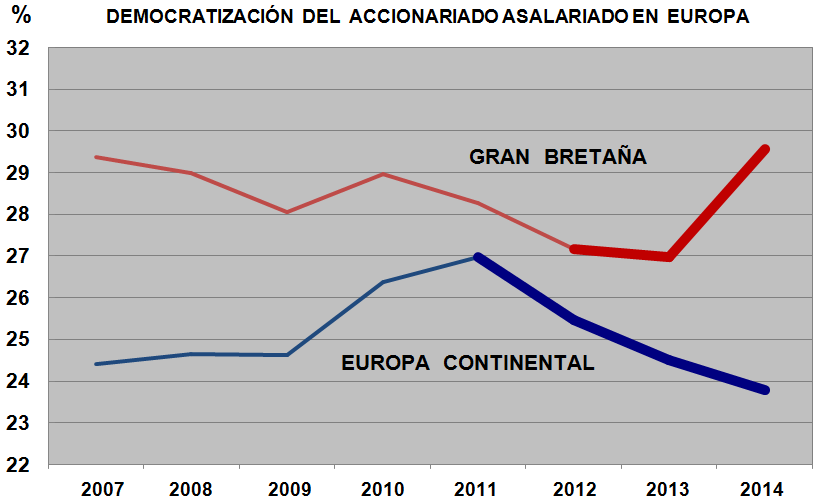
Enero 2015 - Signal
d'alarme
Pour la troisième année de suite en 2014,
le nombre d'actionnaires salariés en Europe
à régressé. Ceci devrait être un signal d'alarme
pour tout le monde. En fait, le nombre d'actionnaires
salariés a diminué de 500.000 personnes en
Europe continentale entre 2011 et 2014 (-8%)
alors qu'il augmentait de 200.000 personnes
en Grande Bretagne (+8%). Ces changements
sont à mettre en relation avec les politiques
fiscales régressives dans beaucoup de pays
européens, alors qu'au contraire, la Grande
Bretagne a fait le choix de doubler les incitants
fiscaux pour l'actionnariat salarié, considérant
son développement comme un facteur de sortie
de crise et un investissement pour l'avenir.
Telles sont les premières indications de notre
recensement annuel de l'actionnariat salarié
dans les entreprises européennes. Plus
d'information
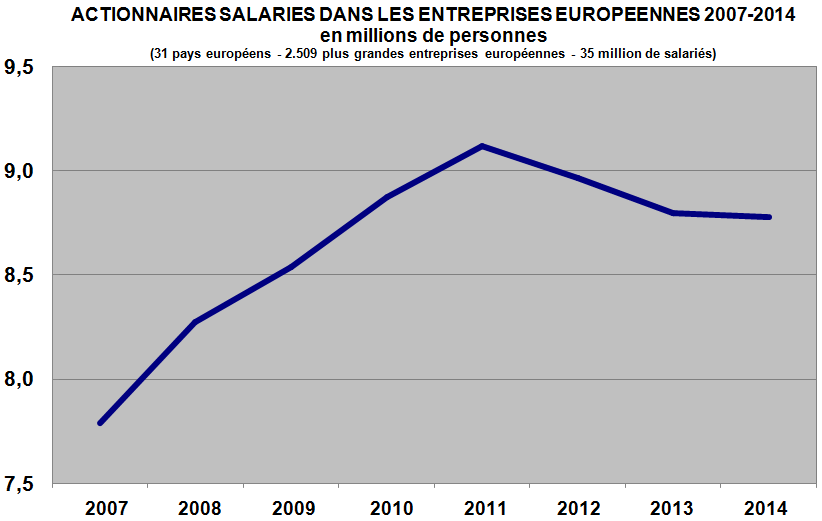

The
Virtual Information Center for employee ownership
and participation offers a full picture of
each country of the European Union. For each
country, it offers a summary of dedicated
legislation as well as a short information
about fiscal, social, political and cultural
aspect of employee ownership and participation.
It is on the Internet and it is for free. More information
December
2014 - Italy on the right way
On November 30 the Italian Government
approved the Parliamentary Motion presented
by MPs Tidei, Galperto and Bargero about the
promotion of employee share ownership in Italy.
The document is largely inspired by the EFES
positions and activities. Its aim is to promote
employee share ownership through a new legislation
and through a dedicated budget. See
more in Italian
|
|
The
study entitled "Employee Financial Participation
in Companies' Proceeds" was published
by the European Parliament in September 2012.
Authors
of the study were severely condemned by the
Court of Justice of Brussels and the study
had to be definitely removed by the European
Parliament. Authors of the study are
a consortium made of Ecorys and Case, represented
by Professors Jens Lowitzsch and Iraj Hashi.
In addition, the study seriously misled
the Parliament on two major points. More
information
November
2014 - Back
to fiscal incentives
It
is well known that fiscal incentives are the
key point for the development of employee
share ownership. Australia: The Labor
Government decided in 2009 to cut fiscal incentives
for share option plans, leading to a disaster
for employee ownership and entrepreneurship
in Australia. Now they're back: “We are reversing
the changes that the former government made
in 2009 which essentially stopped employee
ownership in this country,” Prime Minister
Abbott said. Denmark: Fiscal incentives
on employee share plans were removed in 2012.
Now they're back: Legislative amendments are
presented in this sense to the Parliament.
The Netherlands and Greece: Fiscal
incentives were removed in 2012. When will
reason come back there? France: Surprising
Government's order removes the whole legislation
which formerly encouraged employee share ownership
in case of privatisations. At the same time,
the British Government recently doubled fiscal
incentives for employee share plans in the
UK, as a key element of recovery. And former
European Commissioner Michel Barnier just
launched a call in the British and French
press, telling that "Europe can only
gain if we embrace employee share ownership",
and calling the new European Commission to
bring support in this sense. More
information in our press review
|
October
2014 - Manifesto
2014: Fiscal incentives are
indispensable prequisites |
|
|
Worldwide practical evidence
and a wide range of academic research
support the view that a proper legal
environment and the provision of suitable
fiscal incentives are indispensable
prerequisites for any policy truly aiming
the development of employee share ownership.
Moreover,
such evidence and research also show
that fiscal incentives always pay off
medium/long term and in many ways.
Organisations promoting employee owner-ship
around the world have demanded persistently
and consistently supportive legislations
including fiscal incentives for the
common good (evidenced in additional
growth and profitability, the spread
of wealth, contribution to economic
and social stability).
New fiscal incentives pave the way to
new encouraging development, while political
decisions reducing or cutting such incentives
always lead to regression.
|
|
September
2014 - To
the new European Commission and Parliament
All
over the world, from the United States to China
and Africa, employee share ownership is highlighted
and promoted as a factor for boosting activity,
greater productivity and better results and
social balance for all. This is also true in
the UK, where fiscal incentives in this direction
have been strongly improved recently.
The development of employee share ownership
can be a major factor of investment and recovery,
also for the European Union. For the EU, this
is the right political choice to do.
Letter
to President Jean-Claude Juncker 17-9-2014
Septiembre 2014 - Manifeste FEAS 2014:
Les incitants fiscaux sont une condition
indispensable
|
Les pratiques éprouvées dans le monde
entier et un large éventail de recherches
académiques ont démontré
la nécessité d'un cadre réglementaire
appuyé sur des incitants fiscaux appropriés,
comme condition indispensable d'une politique
de développement de l'actionnariat salarié.
Les pratiques confirmées par la recherche
ont aussi montré que la balance de ces
incitants fiscaux et de leurs résultats
est positive dans le moyen et le long
terme.
Les organisations qui encouragent le développement
de l'actionnariat salarié dans le monde
entier demandent de façon constante et
forte la mise en place de législations
incitatives et de soutiens fiscaux, dans
un souci du bien commun (pour ce que ces
politiques apportent en termes de supplément
de croissance et de résultats, de partage
des richesses, de contribution aux équilibres
économiques et sociaux).
De nouveaux incitants fiscaux ouvrent
la voie de développements positifs, tandis
que les décisions politiques réductrices
conduisent invariablement à la régression.
|
|
June
2014 - Strong
move in the UK
High fiscal incentives are the base of the successful
policy to promote employee ownership through
ESOPs (Employee Stock Ownership Plan) in the
USA. In contradiction with Europe, this allowed
American public policies to promote employee
ownership in SMEs. Some 11.000 ESOP companies
can be found in the USA compared to only 300
quite similar cases in Europe.
It is now generally admitted in the UK that
such policy has also to be promoted here, leading
to higher productivity, greater levels of innovation
and outstanding financial performances. Finance
Bill 2014 designs two new tax reliefs to encourage
and support the shift to employee-owned companies:
• Under the
first new tax relief, the sale of a controlling
interest in a business to an employee ownership
trust, will be entirely free from capital gains
tax.
• Under the
second tax relief, bonuses of up to £3.600 per
tax year paid to employees of companies controlled
by an employee ownership trust benefit from
an income tax exemption.
These new incentives are still relatively modest
compared to those for ESOPs in the USA but the
UK is clearly showing the right way for all
European countries.
Mayo
2014 - Transparency
It is usually considered in large European
companies that employee share ownership has
to be developed, leading to better performances
and better governance. Top Executives are commonly
the first employees to be encouraged in this
way. More and more companies have "shareholding
guidelines", requiring Top Executives to
hold up to 100-300% of their annual salary in
shares of the company, so as to align employees'
and shareholders' interests. The 2.200 largest
European companies employ some 8.800 Top Executives,
each of them owning 13 million Euro on average
in shares of his company. 77% of all large European
companies are fully transparent about this (see
graph). However, the lack of transparency is
flagrant in a number of European countries:
Greece, Luxemburg, Austria, Belgium, Germany
and some others. A detailed chapter about this
can be found in the European Survey of Employee
Ownership in 2013. More
information
Download
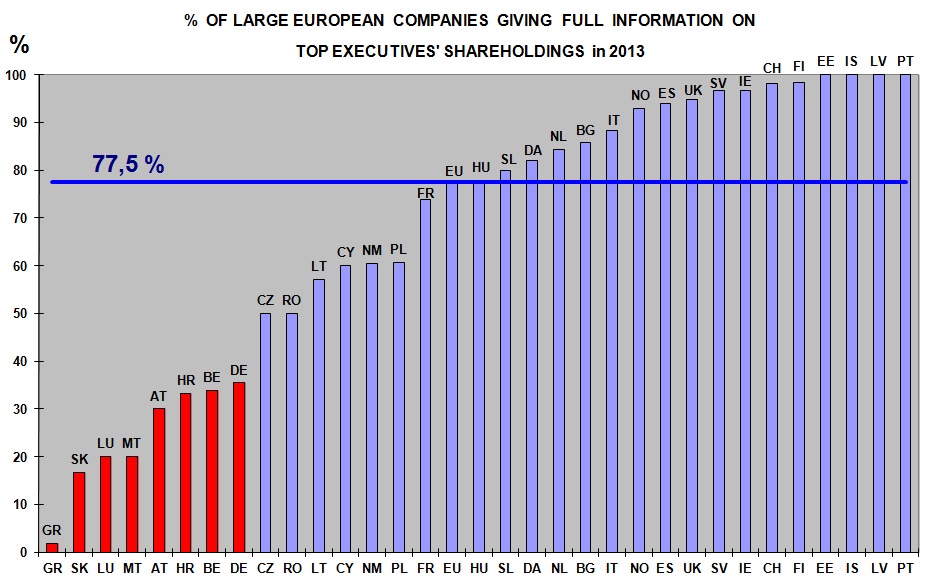
Abril
2014 - Listed
and non-listed companies
It was sometimes told, based on the observation
of specific examples, that non-listed employee-owned
companies could have been more resilient than
others through the financial crisis. Employee-owned
companies might have fared better. This idea
is even a cornerstone of the British Government's
policy to build a wide "employee-owned
business sector" in the UK. The picture
is not the same when based on the systematic
comparison of all large listed
companies and all large non-listed
employee-owned companies in Europe. The graph
hereafter illustrates this through the case
of employment in both types of companies from
2006 to 2013. A detailed chapter about this
can be found in the European Survey of Employee
Ownership in 2013. More
information
Download
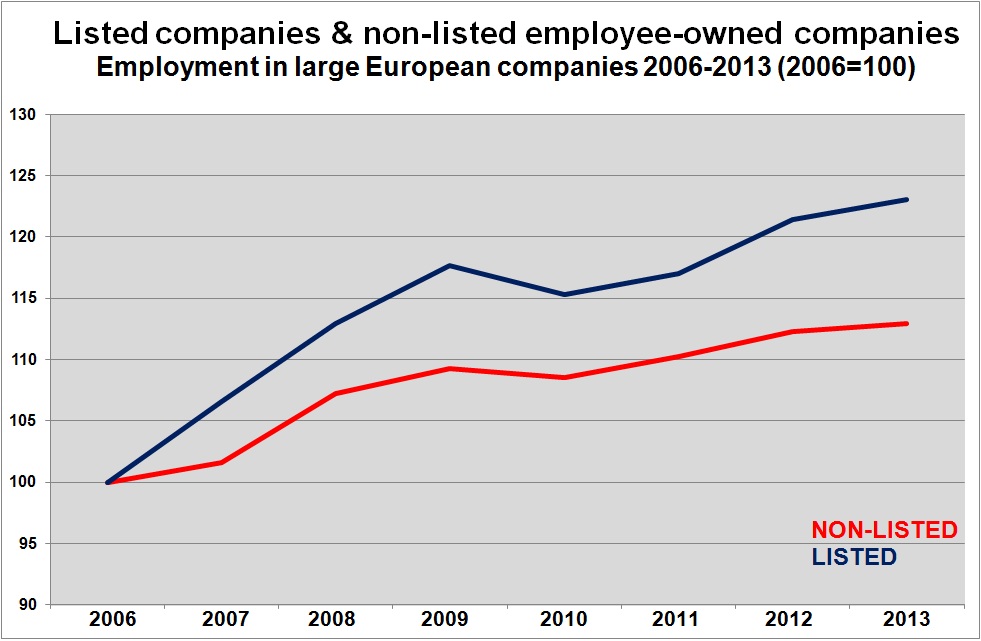
 |
NOW
AVAILABLE !

EUROPEAN
SURVEY 2013
The
whole information about employee ownership
and
employee share plans,
top executives and common
employees in European
companies, corporate
governance and profit-sharing,
employee representation
on boards and discrimination
in employee shareholders'
voting rights, and a comparison
between listed
companies and non-listed employee-owned
companies.
150 pages, 100 tables and graphs.
More
info
|
March
2014 - Discrimination in voting rights
There is no discrimination for or against
employee shareholders' voting rights in most European
countries. However, significant discrimination
can be observed in six countries. Employee shareholders'
voting rights are generally multiplied in France
due to the fact that shares enjoy a double voting
right when held for at least two years. At the
contrary, employee shareholders' voting rights
suffer negative discrimination in five other countries:
Denmark, Germany, Finland, Sweden and The Netherlands.
Typical cases there are companies issuing two
classes of shares, A-shares with 10 votes and
B-shares with 1 vote. Controlling owners hold
high voting shares but employee share plans are
based on low voting ones. This way, employee shareholders'
voting rights are severely discriminated, in up
to 45% of large companies in Sweden. More
info
Febrero
2014 - Still
more employee share plans in Europe
The EFES Survey of employee ownership in 2013
is soon available, showing that still more and
more of European companies organize employee share
plans. In 2013, 85% of all large European companies
had employee share plans of all kinds, while 53%
had "broad-based" plans for all employees
and 63% had stock option plans... More
Download
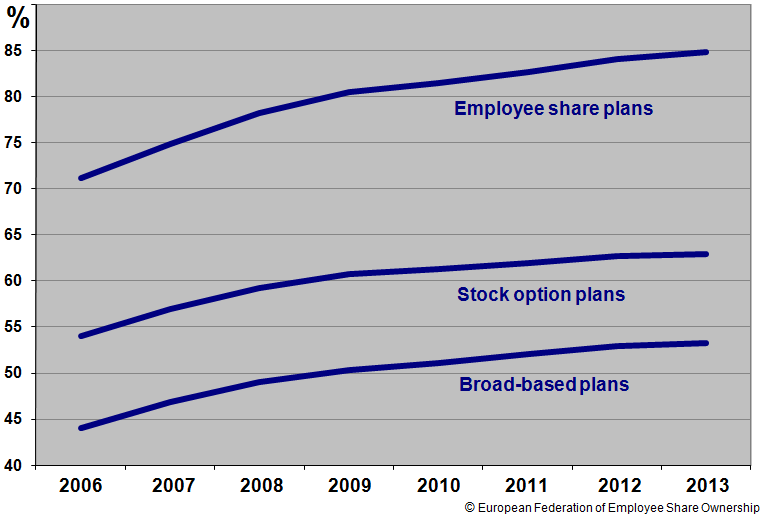
Janvier 2014 - 266
milliards d'Euro en 2013, comme avant la crise
financière
En 2013, le capital détenu par les salariés
dans les entreprises européennes a augmenté de
32% à 266 milliards d'Euro, au même niveau que
juste avant la crise financière. En pourcentage,
la participation détenue par les salariés n'a
jamais été aussi élevée avec 2,99%. Cette nouvelle
progression n'est due que secondairement à de
nouveaux plans d'actionnariat salarié (environ
30% des grandes entreprises européennes ont lancé
de nouveaux plans d'actionnariat salarié, comme
d'habitude). La raison principale? Les prix des
actions ont augmenté davantage dans les entreprises
où la part de l'actionnariat salarié est la plus
grande, conduisant mécaniquement à une participation
moyenne plus élevée. C'est remarquable. Plus
Télécharger
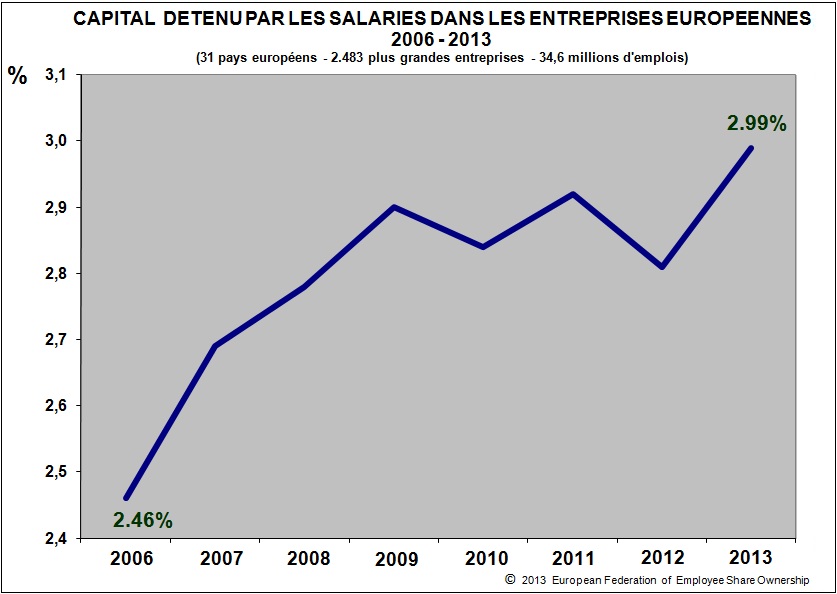
Janvier 2014 - Politique
de plus en plus favorable en Grande Bretagne
La
fiscalité des plans d'actionnariat salarié va
être deux fois plus encourageante. Fantastique
nouvelle pour des millions d'actionnaires salariés,
dit la presse anglaise. La politique économique
se fonde toujours plus sur l'actionnariat salarié
comme clé d'un modèle économique durable. Les
années récentes ont vu se développer l'idée que
l'actionnariat salarié devrait viser en priorité
à donner aux salariés une part de contrôle dans
les PMEs ("employee ownership"), plutôt
que de favoriser un actionnariat salarié minoritaire
dans les grandes sociétés cotées en bourse ("employee
share ownership"). Le premier choix du Gouvernement
est allé dans ce sens, avec un ensemble de mesures
de soutien pour un montant global de 50 millions
de livres, alors que des voix se faisaient même
entendre pour proposer la fin des avantages fiscaux
pour les plans d'actionnariat salarié dans les
grandes entreprises. A présent un deuxième train
de mesures vient d'être décidé avec 25 millions
de livres supplémentaires pour la promotion des
plans d'actionnariat salarié. Les montants immunisés
d'impôts des plans d'actionnariat salariés les
plus populaires dans les grandes entreprises seront
doublés, passant de 250 à 500 livres par mois
pour les plans SAYE et de 1.500 à 1.800 livres
par an pour les plans SIP.
Diciembre 2013 - Nouvel
indice boursier de l'actionnariat salarié
En
Grande Bretagne, l'indice boursier Employee Ownership
Index (EOI) vient d'être relifté et depuis juin
2013, il est calculé chaque jour par FTSE International.
L'index a été créé il y a de nombreuses années
pour tester l'hypothèse que les entreprises avec
un fort actionnariat salarié ont une meilleure
performance sur le long terme. Le EOI est un indice
des sociétés cotées sur le London Stock Exchange.
Curieusement, l'image des performances donnée
par la nouvelle version du EOI est assez différente
de ce que montrait la version précédente... Plus
Diciembre 2013 - Les
salariés dans les conseils d'administration en
Europe
La
représentation des salariés dans les conseils
est courante dans beaucoup de grandes entreprises
européennes, que ce soit dans les conseils d'administration
ou les conseils de surveillance. En France, cette
représentation est particulièrement raffinée.
Les salariés sont représentés dans les conseils
qui comptent pour 51% des emplois dans les grandes
entreprises. La représentation des actionnaires
salariés couvre 29% des emplois et celle des salariés
(actionnaires ou non) couvre 36% des emplois,
tandis que 14% des emplois dans les grandes entreprises
sont couverts par une double représentation dans
les conseils, comptant à la fois des représentants
des actionnaires salariés et des représentants
des salariés. La publication détaillée sur la
représentation des salariés dans les conseils
vient de paraître… Plus
Novembre 2013 - Les
salariés dans les conseils d'administration
La
représentation des salariés dans les conseils
est courante dans beaucoup de grandes entreprises
européennes, que ce soit dans les conseils d'administration
ou les conseils de surveillance.
En
France, les actionnaires salariés sont représentés
dans les conseils d'administration de 13% des
grandes entreprises (qui comptent pour 29% en
termes d'emplois). La participation des actionnaires
salariés dans les conseils est donc typique des
très grandes entreprises.
Pour la représentation des salariés dans les conseils,
elle est la norme en Europe pour 36% des salariés
des grandes entreprises. On le voit dans le graphique
ci-dessous. C'est le cas pour 95% des salariés
des grandes entreprises en Autriche, en Allemagne,
en Slovénie. En France, c'est le cas pour 51%
des salariés dans les grandes entreprises (juste
au-dessus de la moyenne européenne), alors que
c'est le cas pour 2,3% des salariés seulement
en Grande Bretagne… et 0% en Italie.
Notre base de données des grandes entreprises
européennes a d'abord rassemblé toute l'information
sur l'actionnariat salarié dans les 2.200 plus
grandes entreprises européennes (ce qui représente
25% de toutes les entreprises cotées en Bourse
en Europe mais 94% en termes d'emplois et 97%
en termes de capitalisation). Elle s'élargit maintenant
aux questions de gouvernance d'entreprise. Une
publication détaillée sur la représentation des
salariés est à présent disponible.
Télécharger
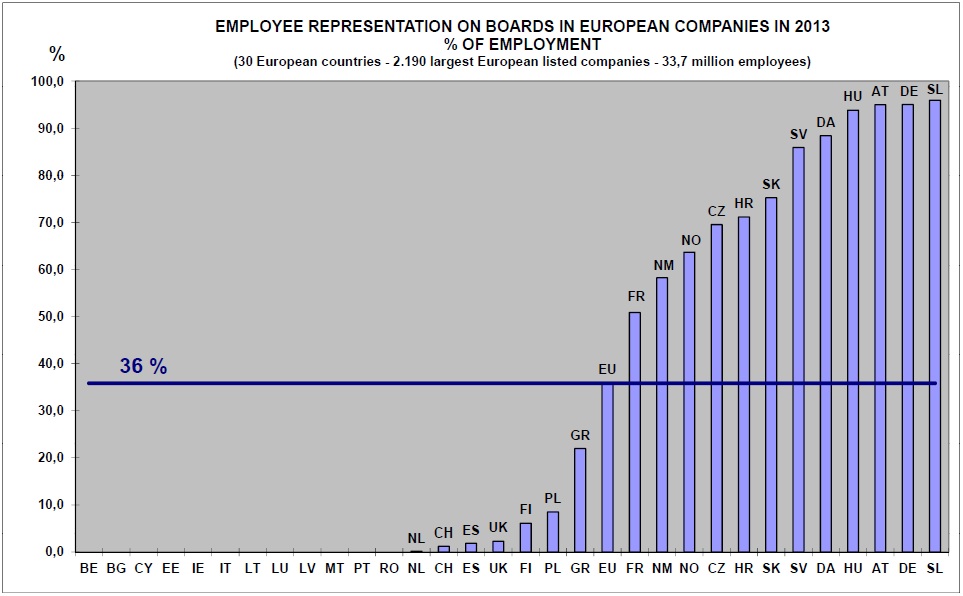
October
2013 - European Trade Union Institute
A dedicated Internet site worker-participation.eu
was set up as "the gateway to information
on worker participation issues in Europe",
a remarkable work by the European Trade Union
Institute (ETUI). It is about employee participation
which includes the following pieces: Trade unions,
collective bargaining, workplace representation,
board-level representation, European-level representation,
representation in the area of health and safety,
and finally employee financial participation.
In the European unions' vision, employee share
ownership belongs to employee financial participation,
which has two main branches: Profit-sharing and
employee share ownership. Profit-sharing is considered
as "the simplest form of financial participation.
This can be understood as a collective regulation
that, in addition to the stipulated wage, provides
a variable income dependent on enterprise profits"
– Variable pay, in fact. Finally, employee share
ownership appears in the European unions' vision
as the last piece of this participative building.
More
information
Septiembre
2013 - European
Commission's Action Plan for employee share ownership
The European Commission recently published
its new Action Plan. In summary, the following
actions will be taken:
• The Commission will analyse the
subject in more details.
• The Commission will identify which
initiatives may be appropriate to encourage the
development of trans-national employee share ownership
schemes in Europe.
• The Commission will identify and
investigate potential obstacles to trans-national
employee share ownership schemes.
• Subsequently the Commission will
take appropriate action to encourage employee
share ownership throughout Europe.
Full details about this new action plan are available
for download
here.
July
2013 - Rectification
about European Parliament's study
The European Parliament – Economic & Scientific
Policy Department published a study named "Employee
Financial Participation and Companies' Proceeds".
This study published by the European Parliament
was quoted by the European Commission as the most
recent element of the "European background",
in its call for tender for the implementation
of the European Pilot Project for the Promotion
of Employee Ownership and Participation… More
information
|
|
Disponible
el libro "La participación financiera de las
personas trabajadoras"
Ya
está disponible en la web de Confesal la versión
en pdf del libro "La participación financiera
de las personas trabajadoras en la empresa"
financiado por Confesal y la EOI y elaborado
por Asle. Se trata de una publicación derivada
del estudio realizado por la Agrupación de
Sociedades Laborales de Euskadi, con el objetivo
de poner en valor la cultura de la participación
como medio para alcanzar una mayor cohesión
social y favorecer el desarrollo y la competitividad
de las empresas, así como incrementar el grado
de conocimiento en España sobre la participación
financiera de las personas trabajadoras.
Leer
más |
April
2013 - For the first time since
the financial crisis occurred...
… the number of employee shareholders in Europe
didn't increase last year, and the democratization
rate of employee ownership went down.
A new differentiation appears between top executives
and other employees since the beginning of the
crisis. The share held by common employees is
continuously decreasing since 2009. At the contrary,
top executives increased their share in companies'
capital. As a consequence, the average capitalization
held by each of the 8.845 top executives in large
European companies raised to 9,1 million Euro
in 2012, compared to the average capitalization
of 11.500 Euro held by each of the 9,6 million
common employee shareholders.
This picture of a first decrease in the democratization
of employee ownership since the financial crisis
may be related to some recent negative political
orientations decided in a number of European countries
regarding employee share ownership, for instance
in Ireland, The Netherlands, France, or even in
the UK.
In addition, nothing effective
was made for the promotion of employee share ownership
in Eastern and Southern Europe.
These are the
main conclusion of the new Economic Survey of
employee ownership in European countries in 2012.
More
information
Marzo
2013 - A new film on employee ownership in the
USA
What does it mean to be an employee owner?
We the Owners: Employees Expanding the American
Dream tells the story of three employee-owned
companies: New Belgium Brewing, Namasté Solar
and DPR Construction. ESOP companies are the most
typical way for employee ownership in the USA
(an ESOP is an Employee Stock Ownership Plan).
This model is particularly designed for business
transfers to employees. In this sense, it is clearly
the most effective in the world, being shaped
as a pension plan with strong tax incentives for
both family owners (selling the company to employees)
and employees (buying usually 100% of the company
for peanuts). More
information
Febrero
2013 - New era for employee share plans in the
UK
The British government has given the green
light to substantial simplification and reform
of all four approved share ownership schemes during
the course of the next 15 months. This follows
the exhaustive review of the approved schemes
by the Office of Tax Simplification, which concluded
that major changes had to be made quickly to head
off strangulation of the employee share ownership
sector by overregulation and excessive bureaucracy.
More
January
2013 - New support from the European Union
in 2013
Both European Commission and Parliament will
bring more support for employee ownership in 2013.
The European budget was voted by the European
Parliament, including a budget heading for a pilot
project for the setting up of a Center for Employee
Ownership in each Member State, to deliver information,
education and promotion of adequate legislation.
In addition, the European Commission announced
its Action Plan to modernize European company
law and corporate governance, including measures
on employee share ownership. More details
December
2012 - A
new wave for employee ownership across Europe
A new wave boosting employee share ownership
seems growing from major European countries. Great
Britain: Employment Relations Minister Jo
Swinson told that the British Government will
do all in its power’ to extend employee share
ownership substantially within the UK. "We
have to eliminate the barriers which inhibit the
installation of employee share schemes and employee
ownership in UK businesses", she said. "Over
the years employee ownership and employee share
ownership have not been nearly as far up government
agendas as they should have been. For the workforce
is our human capital and must be encouraged accordingly",
said Ms Swinson. "Much more employee share
ownership was needed now in large and small companies
alike, because such schemes were an important
factor in economic growth" the minister told
to the Employee Share Ownership Center in London.
France: President François Hollande announced
a new legislation for employee share ownership
and participation. Germany: As promised
by Minister Philipp Rösler, the German Ministry
of Economics and Technology launched a new Internet
portal for employee ownership. Italy: Waiting
for a new law on participation and employee ownership.
The Parliament appointed the Government at the
end of June, but the white smoke is still awaited
in Rome.
November
2012 - British
Government's plans to boost employee ownership
sector
British Government announces its plans to boost
employee ownership sector. The plans include assessing
whether to establish an independent Institute
for Employee Ownership, an ‘off the shelf’ model
for setting up an employee owned business, work
to examine the guidance on tax issues relating
to employee ownership, a guide for staff and employers
to request and agree an employee ownership takeover
and work with the John Lewis Partnership to examine
the barriers to funding for private sector employee
owned companies. More
details
November
2012 - Employee
owner or sub-employee owner?
To be or not to be? We are still in the UK of
course. Every day brings its new ideas to boost
employee ownership. Chancellor George Osborne
announced the new "employee-owner" contract:
Employees could be given shares in their companies
in exchange for giving up certain employment rights
under plans for a new type of employment contract.
Storm of controversy! Would you trade your employment
rights for shares? "Osborne's announcement
is a big boost to employee ownership scheme",
the Employee Ownership Association said. And again:
"Employee ownership is now being embraced
as the most prominent alternative to the over-dominant
PLC model and its inherent short-termism."
The National Center for Employee Ownership said
Chancellor Osborne’s proposals were "awful",
a “very bad idea” and that no “rational person”
would give up employment rights for a small capital
gains tax break. Finally, most employee ownership
organizations agreed that the rights of workers
couldn't be reduced in order to grow employee
ownership. See press
review for all details
Octobre
2012 - Employee
Ownership Index
Would you like investing in a financial tool
if it is not transparent? Hopefully not! The Employee
Ownership Index is published in the UK by a law
firm in London. It shows that companies in the
EO Index outperform FTSE All-Share companies over
the long term by an average of 10% each year since
the EO Index began (see graph). Not bad!!! Our
question to this law firm was: "Which companies
belong to the Index?" Here is the answer:
"I'm afraid we don't give out the names of
companies in the index". Maybe the only stock
index in the world whose components are unknown.
Would you like to comment on this or ask your
own questions, please
use this link
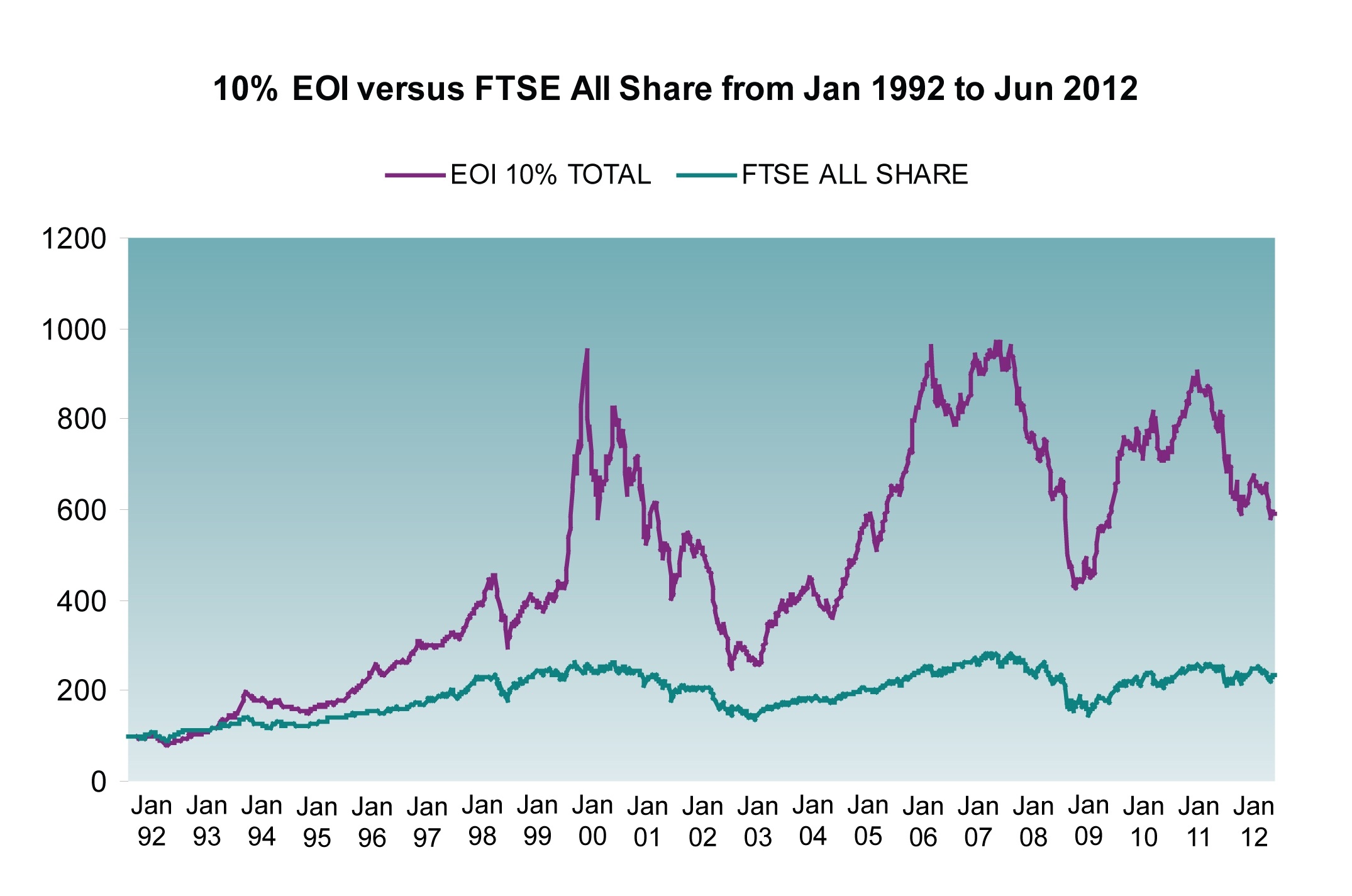
September
2012 - A new era
of capitalism in the UK
The British Government announces a new era
of capitalism. "Never before, employee ownership
had so much attention in the UK", Minister
for Employment Norman Lamb said. They are going
"to shift employee ownership into the mainstream
of corporate Britain". On the other hand,
the British administration for Revenue & Customs
(HMRC) launched a public consultation about employee
share plans. Something should be done in priority
about employee share plans in large companies,
as the comparison with France shows. This is appearing
from the
EFES answer to the HMRC consultation
September
2012 - Typology
of employee ownership
Based on empirical and statistical observation,
a typology of employee ownership can be identified:
Up to 1% employee ownership appears to be insignificant
or embryonic, over 1% it is becoming significant,
over 6% it is strategic, over 20% it is determining,
and over 50% it is controlling. Of course, here
is a link with corporate governance issues. It
is remarkable that employee ownership appears
to be strategic, determining or controlling, not
only in small and medium sized enterprises, but
even in a high number of the largest European
companies. More
information
July
2012 - Employee Ownership Summit 2012
British Deputy Prime Minister Nick Clegg together
with Ministers Norman Lamb and Francis Maude organized
the first Employee Ownership Summit on July 4
in London. "We are completely enthusiastic
about employee ownership" Norman Lamb said.
"Never before, employee ownership had so
much attention in the UK." It is a fact that
the British legislation for employee ownership
revealed itself to be much less effective than
the French one. More
information
July
2012 - Key recommendations to the British
Government
Growing the economy is the British
Government's most pressing priority. The Government
adviser on employee ownership published its report,
including his 28 recommendations to promote employee
ownership in the UK. The recommendations focus
mainly on the promotion of employee ownership
in small and medium sized enterprises, at least
25% employee-owned. More information
July
2012 - The Nuttall Review of Employee Ownership
The British Government adviser on employee
ownership publishes its report, including his
28 recommendations to promote employee ownership
in the UK, in line with the British Governments'
aim of shifting employee ownership into the mainstream
of corporate Britain. The
Nuttall Review of Employee Ownership
Junio 2012 - The
European Parliament at work
During the public hearing we organised in
the European Pa rliament on March 22, we asked
for a dedicated budget heading of 2.5 million
Euro for the promotion of employee ownership across
Europe. A clear, simple, cheap proposal. It will
allow information centers about employee ownership
to be organised in every member state of the EU.
This is the key-point to combat obstacles to multinational
employee share plans, a condition for "a
single market for employee ownership". Now
the Parliament is working. We hope an effective
decision will be taken. More
information
Junio 2012 - Democratization
rate of employee ownership in Europe
The democratization rate of employee ownership
is calculated as the proportion of employee owners
among all employees. It was continuously rising
in European companies for 30 years and even through
the recent financial crisis (see graph). It was
30.1% in 2011, which means that one-third of all
employees are now co-owners of their company.
This rate of democratization should still increase
to 50-60% in the near future. More
information
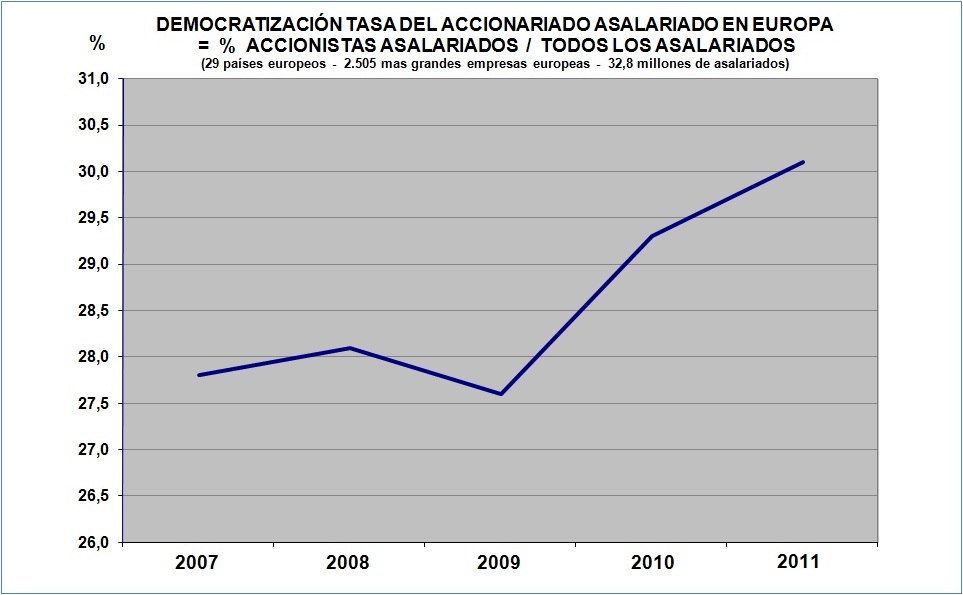
May 2012 - Report
of the public hearing in the European Parliament
|
|
|
The
Report of the public hearing is now available.
The public hearing in the European Parliament
was held on March 22 thanks to Pervenche Berès,
Chair of the Committee on Employment and Social
Affairs and with Commissioner for Internal
Market Michel Barnier.
A budget proposal was laid on the table of
the Parliament for supporting the development
of employee ownership in all European countries…
Download
the full Report |
May 2012 - Survey
of Employee ownership in European countries in
2011
The new Survey is now available. It is based on
the census of employee ownership in each of all
2.505 largest European companies, employing 32,8
million people in 2011. Content: Main findings
of census 2011, more than 50 tables and graphs,
democratization ratio of employee ownership in
various European countries, relative shares of
Top Executives and other employees, list of most
remarkable cases... More
information
April 2012 - Commissioner
Barnier: Employee ownership,
symbol of social cohesion
Employee ownership is a symbol of the social
cohesion which Europe needs in this time. It has
to be supported at all levels. This was the conclusion
expressed by the European Commissioner for Internal
Market Michel Barnier and the President of the
Commission for Employment and Social Affairs of
the European Parliament, Pervenche Berès, after
the public hearing held in the European Parliament
on March 22. A budget proposal was laid on the
table of the Parliament for supporting the development
of employee ownership in all European countries…
More
information
April 2012 - Employee
ownership in European countries in 2011
Capital held by employee owners in European companies
raised to 232 billion Euro in 2011, not so far
from its highest in 2007, and the share held by
employees in their companies increased to 2.83%,
going back to its positive trend (see graph hereafter).
More
information
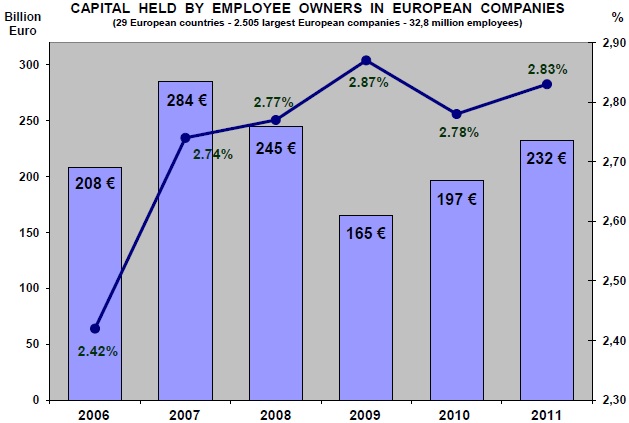
March 2012 - Employee
ownership in European countries in 2011
The most recent numbers show that employee ownership
was continuously progressing across Europe since
the financial crisis. This is the main conclusion
of the new "Economic Survey of Employee Ownership
in European Countries in 2011". The conclusion
was the same in 2010, this is thus a confirmation.
In 2011, 9.9 million employee owners held 232
billion Euro in their companies' shares compared
to 9.5 million holding 197 billion Euro one year
before. The number of employee owners increased
more in Spain, Sweden, Denmark and France, while
it was decreasing in Italy, Greece and Portugal
as well as in Germany, Belgium and Ireland.
The survey brings exhaustive information. It is
based on the census of the 2.505 largest European
companies employing 32.8 million people in 2011.
More
information
February 2012 - Public
hearing in the European Parliament on March 22
The European Economic and Social Committee recently
launched a call on the European institutions and
governments for a renewed initiative supported
by the EU budget through a dedicated budget heading.
Such a budget should help to set up and finance
a European Center for Employee Ownership in each
European country, to deliver information, training
and advice to employees, enterprises and the public
at large. The public hearing in the Parliament
on March 22 will be the opportunity for a budget
proposal.
Program
of the hearing Budget
proposal
December 2011 - Employee
share ownership and the EU corporate governance
framework
In 2011, the European Commission published
a Green Paper and they organized a public consultation
about the EU Corporate Governance Framework. Question
23 was about employee ownership: "Are there
measures to be taken, and is so, which ones, to
promote at EU level employee share ownership?"
Many companies, enterprises organizations, unions,
organizations of the civil society and public
authorities answered the consultation. About employee
share ownership, the Commission received 252
answers from 34 countries. It is remarkable that
answers are globally positive. In fact, the global
quote is positive at 65%. However, it is sad that
the question was ambiguous: Many people answered
positively, supporting the idea that employee
ownership should be promoted by the EU, while
others gave negative answers fearing that the
EU could restrict their freedom in the field (for
example, most Swedish companies gave the same
hard negative answer). More
information
December 2011 - Curriculum
Library on Employee Ownership (CLEO)
CLEO, is the largest online academic repository
of teaching and background materials on employee
ownership. CLEO offers over 500 materials (e.g.,
books, articles, cases, teaching modules, etc.)
to help with research and teaching on a broad
range of topics on employee ownership; more recent
newly developed works and educational cases, syllabi,
and curriculum; teaching modules and reading collections
with suggested relevant materials. More information
November 2011 - The
EU Corporate Governance Framework
The European Commission organized a public
consultation about "The EU Corporate Governance
Framework". All contributions are now public,
including ours. Question 23 is about employee
ownership: "Are there measures to be taken,
and is so, which ones, to promote at EU level
employee share ownership?" Of course we answered
positively, arguing that "Employees' interest
in the long-term sustainability of their company
is going to be increasingly a crucial element
of trust and corporate governance. Not only can
employee owners contribute greatly to increase
the proportion of long-term shareholders, but
we will also see that employee ownership itself
will be more and more perceived as a trust indicator."
We are delighted to see that so many organizations
too gave encouraging answers, including international
unions like ETUC or UNI. All contributions are
available here,
while the EFES' one can be downloaded here
November 2011 - Euroshareholders
Euroshareholders is the organization of European
shareholders associations. It was founded in 1992
while the European Federation of Employee Share
Ownership was founded in 1998. Both organizations
developed a good cooperation for many years, considering
a number of common objectives regarding corporate
governance in Europe, shareholders' rights and
equal treatment of all shareholders, harmonization
at the EU level on shareholders issues, financial
education and scientific research on capital market
and finance. Both organizations recently decided
to reinforce their links. The recent general meeting
of Euroshareholders in The Hague welcomed the
EFES as a new associate member, while Euroshareholders
will reciprocally join the EFES. More information
October 2011 - New call from the European institutions
The
European Economic and Social Committee (EESC)
held "the week of employee financial participation"
some days ago in Brussels. The EESC is the body
that gives representatives of Europe's social
partners and civil society a formal platform to
express their points of views on EU issues. A
new call was launched for developing employee
ownership in European companies.
Each Member State of the EU should made available
"an optional simple, uniform incentive model,
with the same tax arrangements and incentives
throughout the EU". This is mainly targetting
an harmonized and easiest way for multinational
employee share plans.
The "ESOP model" for business transmission
to employees in SMEs should be implemented in
the European Union, as it is successfully in the
USA since 1974. This is the only relevant way
to develop employee ownership in SMEs.
A dedicated budget heading should be voted by
the European Parliament, allowing the setting
up and financing of a European Center for Employee
Ownership in each European country, for delivering
information, formation and advices to employees,
enterprises and the public at large.
Septiembre 2011 - Two particular organizations
in the UK
Two
particular organizations has had a major influence
on the popularity of employee ownership in the
UK. The first was founded in 1979, with the help
of the John Lewis Partnership, Scott Bader and
other companies, and originally established as
a consultancy, known as Job Ownership Ltd. It
was the brainchild of Robert Oakeshott, who died
in June this year. Robert was a founder member
of the European Federation of Employee Share
Ownership in 1998. It changed later its name to
the Employee Ownership Association,
acting as "the voice of co-owned business
in the UK". The second organization known
as ifs ProShare was founded
(originally as ProShare) in 1992 by HM
Treasury, the London Stock Exchange and a consortium
of major companies. It provides "a voice
for the Employee Share Ownership (ESO)
industry in the UK".
Septiembre
2011 - Talvivaara
The
employees of Talvivaara Mining Company resolved
on 18 June 2011 to establish a Group personnel
fund to manage the earnings bonuses paid by Talvivaara.
The fund will invest a substantial proportion
of its assets in Talvivaara shares. The fund is
managed by personnel representatives elected by
the employees. Personnel funds are a typical way
in Finland for employee share ownership in large
companies.
Agosto 2011 - European
Top Executives massively buying own company shares
With
the fire sale of shares on the stock exchange,
a strong phenomenon has developed in recent weeks:
European Top Executives are massively buying their
own company shares.
This
can be seen in the hundreds of releases of "insider
dealing". In Italy roundup of Eni, Enel,
Mediobanca, IntesaSanpaolo, Indesit and dozens
of others. Top Executives buying millions of shares.
The same in Germany with Metro, BASF… In Sweden
with Husqvarna… In France Air Liquide, Alcatel-Lucent
... Same at Barclays, Shell... All major companies
are affected.
In
two words: The short-termists sinking into panic,
long-term investors and Top Executives at first
take the opportunity to buy cheap.
What
about the ordinary employee? What's good for Executives
should be good for employees too.
Unfortunately,
any legislation promoting a simple and convenient
employee ownership model is still lacking in too
many European countries.
What
are the worst performers of the European class
in this area? Portugal, Italy, Greece, Spain.
Yes, we find here the same list of countries that
are stigmatized in the crisis of Euro interest
rates. These countries need structural changes,
including the development of employee share ownership.
Also in the back of the classroom: Belgium, The
Netherlands and most Central and Eastern European
countries.
The
consequence of this lack of legislation: In all
these countries, only 10 to 15% of employees are
shareholders of large companies, compared to 30%
on average in Europe. For good students, it rises
to 25, 30 or 50%. These are Norway, Switzerland,
Finland, Great Britain, Sweden, France. It is
remarkable that over the last10 years, employee
share ownership has become an ingredient of the
"Nordic model".
Recently,
the European social partners have launched an
appeal to governments. The European Economic and
Social Committee took this initiative. The Committee
brings together European business representatives,
trade unions and civil society. The opinion is
clear and unambiguous.
Aimed
at large enterprises, each European country should
introduce into its legislation a "simplified
model" of employee share ownership, making
its development stronger and easier.
Aimed
at small and medium sized enterprises, each European
country should encourage the transfer of business
to employees, following the example of what the
U.S. has established since 1974 with the "ESOP
model", allowing employees to buy their business
without paying a cent, with a long-term credit.
The
strength and consistency of employee share ownership
will be more and more one of the factors and one
of the characteristic elements of good governance
in European companies, of better economic performance
and regained trust.
The
opinion of the European Economic and Social Committee
is available on page https://www.efesonline.org/EESC/EN.htm
July
2011 - New research on the impact of employee
ownership
A new research in the USA on the impact of
employee ownership is the largest study ever on
the connections among various forms of shared
capitalism, organizational culture, and company
performance. On the other hand, an important collection of essays edited by
the economists Richard Freeman, Joseph Blasi and
Douglas Kruse and published last year by the National
Bureau of Economic Research documents several
crucial points: About half of all private-sector
workers already have some kind of sharing arrangement
with their employers; sharing tends to make employees
happier, more productive and better off, as long
as they do not take on too much risk by over-investing
in the company they work for, and companies often
benefit as well, showing improved performance
along several different dimensions. In addition,
a large sample of publicly traded companies in
the United States from 1999 to 2008, offers evidence
that companies with employee ownership showed
greater employment stability in face of economic
downturn. Read
more
Abril
2011 - Employee ownership
was continuously progressing across Europe since
the financial crisis
The
number of employee owners was nearly 10 million
in 2010 in large European companies (out of 32.6
million employees). The number of companies that
have employee ownership was increasing (91.7%),
as well as those having share plans for all employees
(53.7%) and those with stock option plans (64.1%).
However, significant differences can be seen between
countries: A significant increase in the number
of employee owners in Spain, Poland, France and
the Nordic countries (Denmark, Sweden, Norway,
Finland), contrasting with a significant decrease
in Belgium, Ireland and The Netherlands.
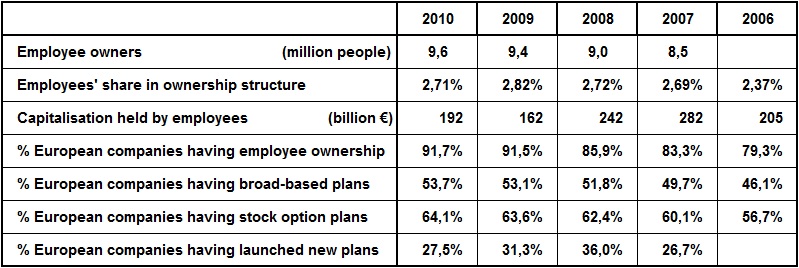
Overall, the capitalization held by employee owners
rose back to 192 billion Euro in 2010. In % held,
there was a slight decline for the first time
for many years (from 2.82% to 2.71%). However,
the share held by Top Executives has increased,
while it is the "common" employees who
have seen their share shrink.
All details are to be published in May in the
next "Economic Survey of Employee Ownership
in European Countries in 2010". Download
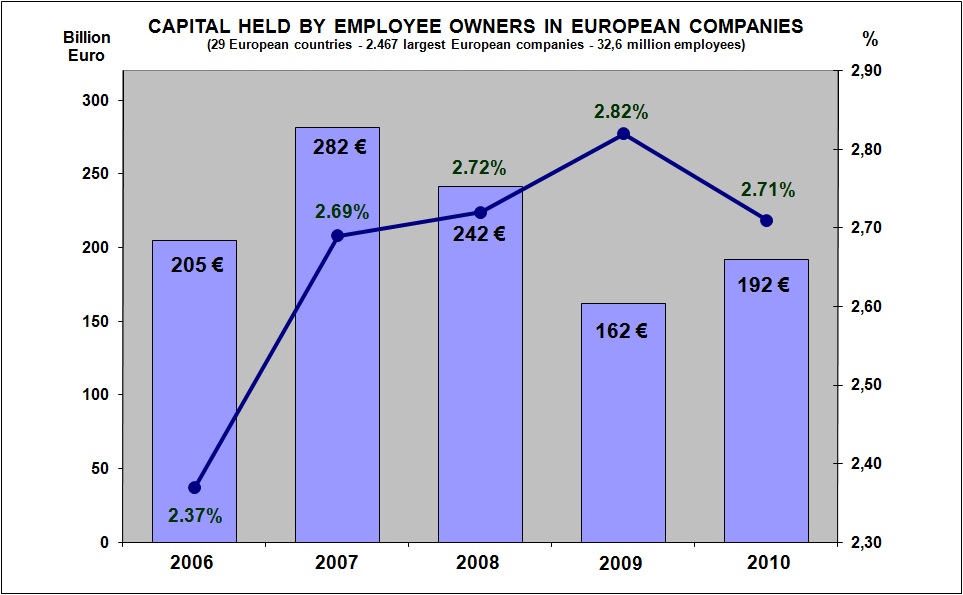
Marzo
2011 - A European Single
Market for employee ownership
European Commissioner Michel Barnier organised
a vast consultation about the new "Single
Market Act". The single market is all about
bringing down barriers and simplifying existing
rules across Europe. It would also include a European
single market for employee ownership. Read
more
Marzo
2011 - Employee ownership improves
company performance
There is a lot of social science evidence today
that shows the combination of meaningful broad-based
employee ownership with a team-oriented corporate
culture improves company performance. Many research
works have been done in the U.S. for long. A first
econometric work is now also available about French
companies: According to the Center for Strategic
Analysis, the social performance of a company
having employee share ownership is 52% higher
than that of companies which have neither employee
share ownership nor employee savings plan. Read
more
Febrero
2011 - Presidency of the European Union
Council – Conference on employee ownership
The conference expressed its support to the European
Economic and Social Committee, asking for:
● Regarding large companies: Each
European country should make available "an
optional simple, uniform incentive model, with
the same tax-arrangements and incentives throughout
the EU".
● Regarding SMEs: Each European country
should strongly encourage business transmission
to employees as the USA did since 1974 – this
is the concept of a "European ESOP model"
for SMEs.
The report of the conference is now available.
Read
more
Febrero
2011 - Center for Strategic Analysis of
the French Republic
According to the Center for Strategic Analysis
of the French Republic, the social performance
of a company having employee share ownership is
52% higher than that of companies which have neither
employee share ownership nor employee savings
plan. The effectiveness of employee share ownership
has to be reinforced by ensuring the representation
of employee shareholders. Read more
Enero
2011 - Controversy about employee ownership in
the UK
John Lewis Partnership was usually described as
the best reference regarding employee ownership
in the UK. How does it work really? Across government
a siren call is sounding, promoting the John Lewis
model of employee ownership as a way of modernising
public services. "But John Lewis is not what
it purports to be", an expert said. "It’s
not an employee run company. The interesting thing
when one looks carefully at the documents that
lay behind that structure it is very difficult
to discern who it is that has responsibility for
the appointment and removal of directors of the
trustee company. In a sense that is almost a self-serving
oligarchy in that it’s the board of directors
on the company that appear on the panel that appoint
and remove the directors and the shareholders
of the trust." More
Enero
2011 - New study shows broad-based Stock Option
Plans improve performance
One of the most comprehensive and convincing studies
to date on the effect of broad-based option plans
on company performance was recently released.
Looking at non-executive options and the subsequent
firm operating performance as measured by the
firm's industry adjusted ROA, the authors found
that "both the existence of a broad based
option plan and the implied incentives of an option
plan exert a positive effect on firm performance..."
By contrast, companies with grants focused on
executives did worse. More
Welcome amendments to the Prospectus
Directive for employee share plans will be in
force by July 2011
We have previously reported on proposed amendments
to the Prospectus Directive - in particular to
the exemption from the requirement to publish
a prospectus in relation to an offering made under
an employee share scheme. The amending Directive
has now been published in the Official Journal
of the European Union and will take effect from
31 December 2010. It must be implemented by Member
States within 18 months. Pinsent
Masons outlines the main changes as they relate
to employee share plans
December
2010 -
Twelve Bogus Reasons Not to Do an ESOP (and
Seven Good Ones)
Over
the years, we have heard a lot of unconvincing
reasons not to do an ESOP—and some very good ones,
too. Unfortunately, too many business owners decided
not to do an ESOP for the wrong reasons. Our goal
is not to convince anyone to implement an ESOP
(or any other employee stock plan). Employee ownership
can grow and prosper only if companies put in
these plans for the right reasons... Twelve
Bogus Reasons Not to Do an ESOP (and Seven Good
Ones) - from the NCEO
September
2010 - European Economic and Social Committee
The
European Economic and Social Committee (EESC)
is the body that gives representatives of Europe's
social partners and civil society a formal platform
to express their points of views on EU issues.
It has a key role to play in the Union's decision-making
process. It is now preparing an own-initiative
opinion on Employee Financial Participation. This
SOC/371 opinion can be downloaded here in all
languages
The concept of financial participation
by employees is experiencing an astonishing upturn
in Europe. However, only a handful of countries
have seen financial participation by employees
introduced on a scale that can be considered as
representing a significant proportion of the working
population. The following points therefore need
to be highlighted:
- The
European Commission's approach – The models should be open to all employees and should
not replace existing forms of remuneration, but
instead supplement them. Additional substantive
measures are needed to promote such broad-based
models.
- Europe
2020
– Employee participation boosts the competitiveness
of European companies by rooting them down in
the region, raising productivity and promoting
sustainability. Its role an entrepreneurial instrument
should be highlighted.
- Promoting
a European model – The modular "building block approach" provides the starting
point for a European model.
- Business
successions in SMEs – The "Employee Stock Ownership Plan" (ESOP) is
a collective employee capital participation scheme,
run by a trust, which for the past 50 years has
proven to be a successful instrument for managing
company succession in the USA.
- State
intervention and participation – Recommendations: Expansion of employee participation
to compensate for state support (for example,
the case of Opel). Promotion of employee takeovers
through lending activities by banks which have
received state guarantees.
- Use
of optional tax incentives to promote employee
participation – Tax incentives are not
an indispensable precondition for employee participation,
but they have undoubtedly had a positive impact
in the countries that offer them.
The opinion will prepare the ground:
- For
a recommendation of the European Council on a
European platform for employee participation,
based on the modular "building block approach".
-
The
incorporation of employee participation in the
Regulation of the Council on the European Private
Company Statute, as well as in the activities
connected with the "Small Business Act".
- The
development of a concept for the European Investment
Bank, encouraging it to link any increases in
loan volume for SMEs to the introduction of employee
participation, especially the ESOP approach for
financing company successions.
Junio
2010 - Beau temps pour l'actionnariat
salarié en Europe
L'Association
française de la gestion financière vient de publier
son enquête annuelle sur l'épargne salariale en
2009: succès, engouement, intérêt croissant. En
Grande Bretagne, les résultats 2009 sont tombés
pratiquement au même moment: boom de popularité
pour les plans d'actionnariat en 2009, forte croissance
de l'actionnariat salarié à travers les plans
d'épargne salariale. Notre propre Recensement
Economique Annuel confirme pour l'ensemble des
pays européens. D'un autre côté, les partenaires
sociaux sont en train de préparer un nouvel avis
d'initiative sur la participation financière des
salariés, dans le cadre du Comité Economique et
Social Européen. Plus
Mayo
2010 - European conferences in Rome
and in Brussels
Two major European conferences will be held
in Rome on September
16-17 and in Brussels
on November 26, 2010. The conference in Rome
is about "Exercising employee shareholders'
rights in European companies". Which are
the good practices? Which models, which obstacles
across Europe?
Could it be more effective? The conference in
Brussels will be
part of the programme of the Belgian Presidency
of the European Union – "Ten years of public
policies for employee ownership in Europe
– past, present, future". Read
more
Mayo
2010 - A cat is a cat
A cat is a cat. This is the present debate
in the European Internet Forum on Employee Ownership.
The financial crisis brings new political awareness
about employee ownership which increasingly appears
the best option for its contribution to healthier
corporate governance, long term vision and stability.
The old concept of employee financial participation
appears now obsolete and confusing. It's easy
for you to join the Forum. Read more
Mayo
2010 - Gnashing of teeth
in France
The
transposition of the Shareholders Rights Directive
sets teeth on edge in France. The member
states of the European Union have to transpose
the Directive into their national legislation.
This one aims to facilitate and encourage effective
shareholder control in EU companies. However,
France failed to implement it in due
time. Furthermore, the transposition project by
the Ministry of Justice brings new difficulties
and obstacles. Read
more
March
2010 - Democratizing employee ownership
Every large European company has 4 Top Executives
on average, each holding 6.475.000 € in his company
in 2009. Most large European companies have now
employee share plans. Most of them express the
idea that employee ownership should be increased
in order to align employees and shareholders'
interests. However, most companies began with
share plans for Top Executives. This is to be
compared with 9.3 million common employee owners,
each holding 10.000 € in 2009. Many discussions
occurred recently about Executives' remunerations.
What about ownership? More
March
2010 - Employee shareholders rights
in European companies
Which are the good practices? Which models,
which obstacles across Europe? Could it be more
effective? A European Report will be written with
the support of the European Commission and a European
Conference will be held in Rome on September 16-17,
2010. It will contribute to open a new door for
social dialogue and corporate governance items.
Here the new dedicated website
March
2010 - European employees took advantage of lower
share prices
2009
2008 2007 2006
Employee owners
9.3 million 9 million
8.4 million
Employees' share in ownership structure
2.86% 2.79%
2.75% 2.43%
Capitalisation held by employees
166 billion € 249 billion
€ 291 billion € 213 billion €
% European companies having employee ownership
91% 83.8% 81.4%
77.4%
% European companies having broad-based plans
53.1% 50.9% 49%
45.2%
% European companies having launched new plans
30.3% 35.3% 26.5%
In short: European employees took advantage of
lower share prices to increase their share. This
is the main conclusion of the new Economic Survey
of Employee Ownership in the European Countries
in 2009 which will be soon published. More
March
2010 - Go ahead
Employee
ownership is a hot debate in the campaign for
national election in the UK (see press review).
From Paris, the new European Commissioner for
Internal Market, Michel Barnier expressed his
own positive will: "I am going to make a
set of proposals for better corporate governance:
Better transparency, better say from shareholders
about executives' remuneration, better place for
employee ownership…" Go ahead Michel !!…
More
Febrero
2010 - Happy end en Italie
Chaque pays européen est en train de transposer
dans sa législation la Directive McCreevy sur
les droits des actionnaires. Dans un premier temps,
le projet de transposition mettait en danger l'existence
des associations d'actionnaires salariés en Italie.
Heureusement, la nouvelle législation confirme
finalement leur rôle.
 - nouveau logo pour les coopératives de travail
associé en France
- nouveau logo pour les coopératives de travail
associé en France
La
CGSCOP – la Confédération Française des Sociétés
Coopératives de Production lance un nouveau logo
commun pour toutes les coopératives de production
en France… Plus
Enero
2010 - 2010 une année-clé
2010 est une année-clé pour la promotion de
l'actionnariat salarié au niveau politique en
Europe. Après le Parlement, c'est au tour de la
nouvelle Commission Européenne de se mettre en
place. Nous avons adressé une lettre et des propositions
aux nouveaux Commissaires intéressés… Plus
December
2009 - Exercising employee shareholders'
rights in European companies
Which are the good practices? Which models,
which obstacles across Europe? Could it be more
effective? A European Report will be written with
the support of the European Commission, and a
European Conference will be held in Rome in June
2010. More
December
2009 - Australian Employee Buyout
Centre
The Australian Employee Buyout Centre is in
the process of starting up. Its mission is to
preserve, protect and enhance jobs through employee
ownership. More
December
2009 - You can make your contribution
We will be able to continue our information
work thanks to your support. This is why we call
for your contribution. More
November
2009 - Conference chaired by Lech Walesa
in Warsaw
Employee ownership is back on the agenda in
Poland. A conference was held in Warsaw with the
European Federation of Employee Share Ownership
on November 16. Pictures
of the conference
Noviembre
2009 - Peut-être un moment historique
Les crises sont toujours un moment fort pour
de nouvelles idées. Pendant l'été en Allemagne,
on a pu voir le syndicalisme changer son fusil
d'épaule, découvrir l'actionnariat salarié comme
un outil contre la crise financière et demander
une participation dans le capital des entreprises
en difficultés. "Arbeitnehmer sind die besseren
Aktionäre" (le meilleur actionnaire, c'est
l'actionnaire salarié)!
Au tour des USA maintenant: le syndicat des métallurgistes
United Steelworkers (USW) et Mondragon Corporacion
Cooperativa viennent d'annoncer un accord cadre
pour collaborer à l'établissement de coopératives
d'actionnaires salariés.
Le
syndicalisme est ordinairement méfiant vis-à-vis
de l'actionnariat salarié, au moins dans un premier
temps. Rien de plus normal. C'est bien le rôle
du syndicalisme de défendre ses membres contre
les risques qu'ils peuvent courir. L'actionnariat
est un risque et c'est aussi le cas pour l'actionnariat
salarié. Celui-ci associe le salarié au
risque d'entreprise.
Leo
Gerard, le Président de United Steelworkers a
mis en exergue la différence entre les plans d'actionnariat
salarié ESOPs (Employee Stock Ownership Plans)
et les coopératives d'actionnariat salarié en
affirmant que "Nous avons eu de multiples
expériences avec les ESOPs et nous avons vu qu'il
ne faut pas longtemps aux types de Wall Street
pour remettre les actionnaires salariés sur la
touche et reprendre le contrôle. Nous considérons
le modèle de la coopérative de Mondragon avec
son principe d'actionnariat "un homme, une
voix" comme un moyen pour les salariés de
reprendre la main et pour remettre la responsabilité
de l'entreprise sur la voie de l'intérêt commun
plutôt que sur celle de Wall Street."
Votes,
responsabilité… C'est de gouvernance qu'il s'agit.
L'actionnariat n'est pas seulement un risque,
c'est aussi la possibilité de dire son mot. Le
risque est encore bien plus grand quand on n'a
rien à dire!
October 2009 - Effervescence in Italy about McCreevy's
Directive on shareholders' rights
Effervescence
in Italy. For now, each European country is in
the process of transposing the "McCreevy's
Directive" on shareholders' rights. In Italy,
the transposition threat to remove the associations
of shareholders. The federation of shareholders'
associations CONAPA convenes its congress on November
10. Detailled information Letter to Minister Sacconi Letter to the Treasury and to the CONSOB
|