|
EFES NEWSLETTER - NOVEMBER 2026
|
EOT-style
cases in Germany
|
|
With
the Employee Ownership Trust (EOT), the UK succeeded
in introducing a scheme that is far and away more effective
than any other for transferring business ownership to
employees.
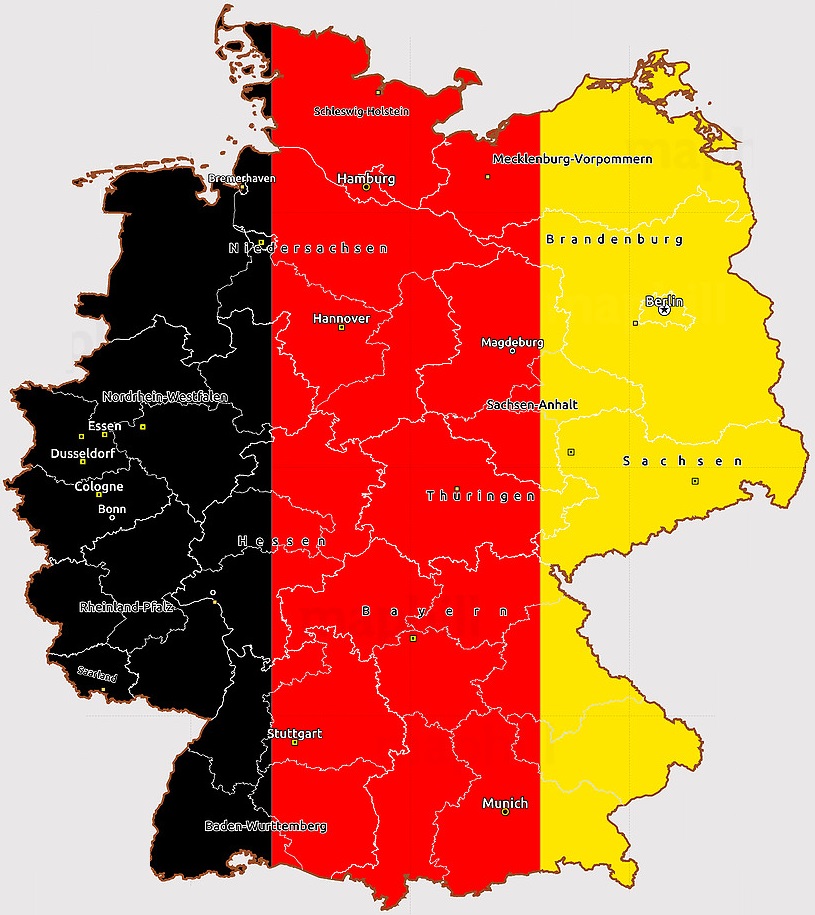
And there are already some good examples of EOT-type
companies in Germany.
A notable recent example is the company ARINEO
(which stands for ARtificial INtelligence Employee Owned).
Since 2024, Arineo’s 350 employees have collectively
owned 100% of the company through an institution known
as a ‘Stiftung’. A ‘Stiftung’ is the German
equivalent of the ‘trust’ in Great Britain.
Other
similar cases have been in existence for much longer.
In 1974, for example, the company MARTIN
HOPPMANN was transferred in its entirety via a ‘Stiftung’,
with the 650 employees as the beneficiaries.
|
|
|
These
observations show that the ‘Stiftung’ can perfectly
well be used in Germany as the equivalent of the ‘trust’
in Great Britain. There is no need to create a new legal
status; no new legislation is required to implement
the legal framework of the Employee Ownership Trust
in Germany.
That said, it is quite another matter when it comes
to implementing the scheme on a large scale, as is the
case in the UK. What makes this possible on a large
scale is that the employees become owners of the company
without having to pay a penny out of their own pockets.
What makes this possible is the credit mechanism.
It is a credit sale. The company’s property is sold
to the EOT on credit. The loan is often repaid over
seven years, and it is the previous owner who provides
the loan. To make this possible on a large scale, tax
relief is the right way forward. It helps to offset
the cost and the risk of borrowing. This tax relief
is clearly identified. This is the scheme that has been
in place for decades in the US for the sale of businesses
to employees, and is also the case in the UK. It involves
exempting the proceeds of the sale of the business from
tax when the business is sold to an EOT.
Whether in Great Britain, Germany or most other European
countries, the social need is the same. The declining
demography and fewer children mean that the transfer
of family businesses is becoming increasingly difficult.
In countries where business transfers to employees are
organised, this method quickly becomes the second most
common after family succession. Transfers to employees
are expected to replace family succession more and more
when the latter becomes too difficult or even impossible.
That is the social and political challenge.
|
|
AI
new mathematics in UK:
Halving
in Cardiff = Doubling in London
|
|
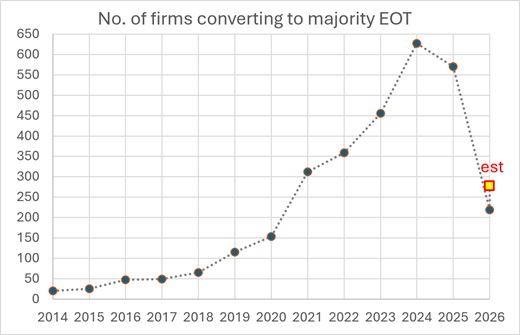
Yearly
moves to employee ownership more than halve, report
Cardiff University academics Guy Major and Jonathan
Preminger, challenging Government manifesto aim.
The
total number of UK companies projected to convert to
ownership by an Employee Ownership Trust (EOT)
in 2026 is less than half the 2025 and 2024 totals,
according to a database collated by Cardiff University
researchers. This is a setback for the Government’s
2024 Manifesto aim of doubling the size of the UK’s
mutuals sector, in respect of EOT-owned businesses.
See
full report and graph hereafter
|
|
|
Press
review
A
selection of 20 remarkable articles in 8 countries in October
2026: Belgium, Canada, Germany, France, Italy, Netherlands,
UK, USA.
Belgium:
Among Belgian SMEs, Easi stands out for its employee share
ownership scheme.
Canada: In surveys of business owners, retirement is
by far the primary reason for transferring one’s business.
Germany: An overview of tax incentives for employee
share ownership in Germany. The magazine *Der Spiegel* is
more than 50% owned by its employees.
France: The “fiducie” (the French legal trust-like
structure) is becoming central to wealth and estate planning.
Cooperatives are a useful tool, though not a panacea.
Italy: New employee share plan at Generali. Giorgia
Meloni pays tribute to the Italian cooperative model. An explanation
of what the "Marcora Law" actually entails.
Netherlands: Employee share ownership is gaining ground
within large family-owned businesses.
UK: Employee share ownership takes a cue from Wales.
Understanding the 10 legal documents that structure Employee
Ownership Trusts.
USA: Employee Ownership Trusts are emerging as an alternative
for business succession.
The full press review is available
on:
https://www.efesonline.org/PRESS
REVIEW/2026/October.htm
|
 A
political roadmap for employee ownership in Europe
The
EFES needs more members. Download the EFES membership form
What's
new on the EFES website?
EFES NEWS
distribution: 200.000
|